Vitalik Buterin
Net Worth
$1.46 billion (as of 2021)
Height
6' (182 cm)
Age
30
Nation
Montenegrin
favorite Personal Life
Basic Information
Family & Relationships
Education
Lifestyle
person_book Biography
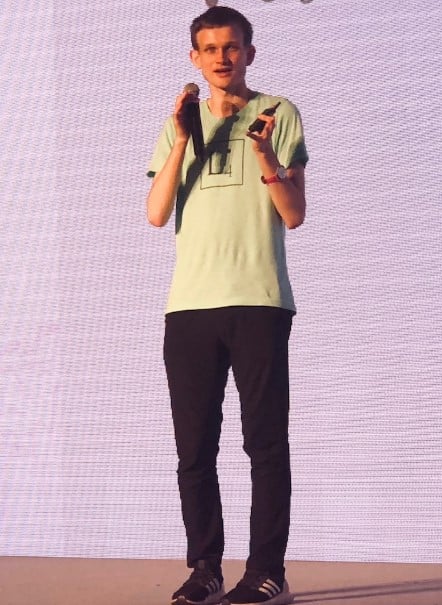
Some Lesser Known Facts About Vitalik Buterin
- Vitalik Buterin lived with his parents in Kolomna, Russia, until he was six.

A childhood picture of Vitalik Buterin with his father in Russia
- In 2001, his parents, Dmitry and Ameline, moved to Canada for better business opportunities. After that, they got divorced.
- When he was in third standard, he was placed in a class for gifted children. There, he developed an interest in mathematics, programming, and economics.

A childhood picture of Vitalik Buterin with a computer
- When he was 17, his father began teaching him about Bitcoin.
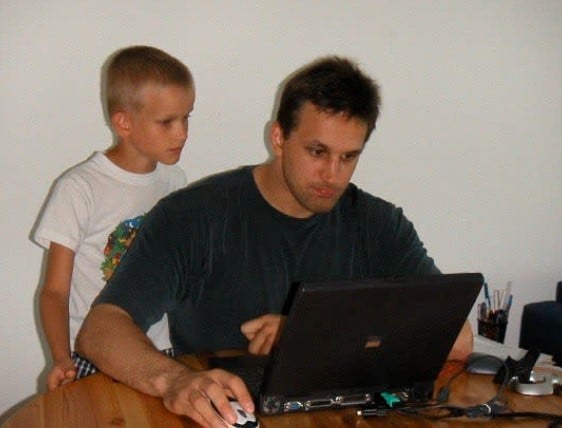
Vitalik Buterin while watching his father working on a laptop
- At the University of Waterloo, he took advanced courses and worked as a research assistant for cryptographer Ian Goldberg, co-creator of Off-the-Record Messaging and former chairman of the Tor Project’s board of directors.
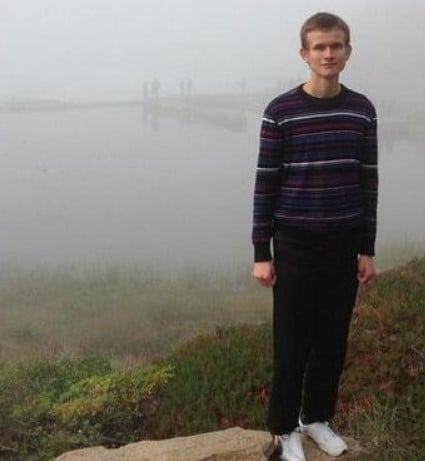
Vitalik Buterin during his college days
- In 2011, Buterin began writing for Bitcoin Weekly for five bitcoins (about $3.50 at the time) for each article. Buterin worked with the site until it shut down due to a lack of revenue.
- In September 2011, a computer programmer Mihai Alisie contacted Buterin and discussed starting a new print publication called Bitcoin Magazine. Buterin accepted the offer and became the first co-founder and a leading writer for Bitcoin Magazine.
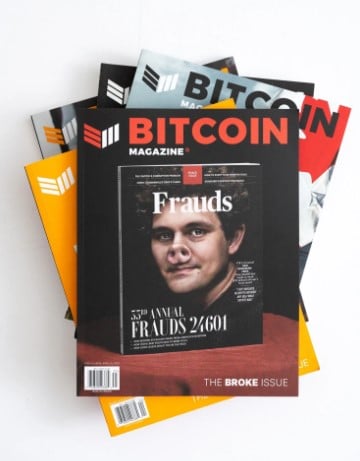
A picture of some copies of Bitcoin Magazine
- In 2012, Buterin participated in the International Olympiad in Informatics in Italy and won a bronze medal.
- In 2012, Bitcoin Magazine started publishing print editions. It became the first certified publication which was dedicated to only cryptocurrencies.
- While working for Bitcoin Magazine, Buterin applied for a job at Ripple. Jed McCaleb, the CTO and founder of Ripple, accepted his offer. However, he could not join because Ripple could not support a U.S. visa for Buterin.
- During this time, he claimed that Bitcoin needed a scripting language for application development; however, he could not gain agreement. He then claimed that he would create a new platform with a more versatile scripting language.
- Buterin then invented Ethereum, which is a combination of a decentralized mining network and software development platform.
- Ethereum enables the creation of new cryptocurrencies and programs that use a shared blockchain, a cryptographic transaction ledger.
- In 2013, he visited other countries and met some noted software developers who shared his passion for coding. After that, when he returned to Toronto, Buterin first described and published Ethereum in a white paper in November 2013.
Logo of Ethereum
- After that, the Ethereum white paper was circulated. Soon, interest in the new platform began growing in late 2013 and early 2014.
- Buterin publicly announced the invention of Ethereum at the North American Bitcoin Conference in Miami on 26 January 2014.
- After this announcement, he delivered a 25-minute speech. He described Ethereum as a general-purpose global computer operating on a decentralized permissionless network.
- In the speech, he highlighted possible uses for Ethereum, including crop insurance, decentralized exchanges, and DAOs (decentralized autonomous organizations).
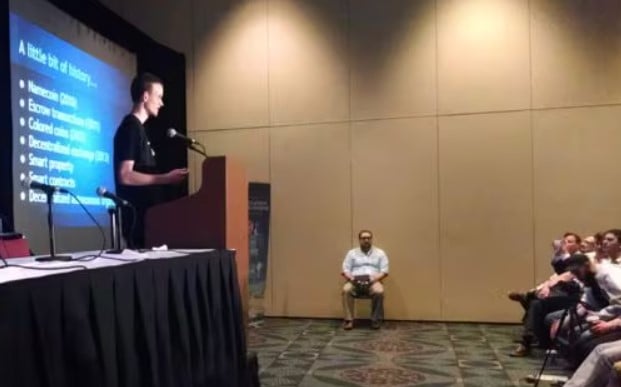
Vitalik Buterin while speaking at the North American Bitcoin Conference in Miami
- He often enjoys working on advanced problems in computer science, economics, and philosophy weekly.
- In 2014, Buterin dropped out of university after receiving a $100,000 grant from the Thiel Fellowship, a scholarship created by venture capitalist Peter Thiel.
- In 2016, Buterin joined the editorial board of Ledger, a journal that publishes original research articles on cryptocurrency and blockchain technology.
- In 2017, Buterin donated $763,970 of Ether to the Machine Intelligence Research Institute.
- Buterin met with Russian President Vladimir Putin on 2 June 2017, at the St. Petersburg International Economic Forum (SPIEF). He described Ethereum’s economic and political importance for Russia.
- After that Putin said that he would establish connections with possible Russian partners regarding Ethereum.
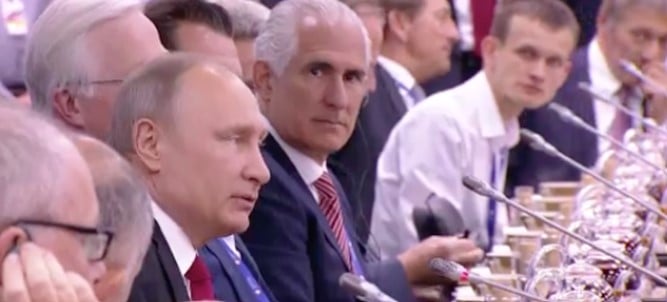
Vitalik Buterin while in a meeting with Russian President Vladimir Putin
- In a 2018 New Yorker article, Buterin’s father mentioned that Buterin did not want to be named as the ‘philosopher king’ of the blockchain world.
- His father added that Buterin wanted to devote his time to research, and he was not excited about the importance the community was providing to him. Buterin wished the community to become stronger and self-dependent.
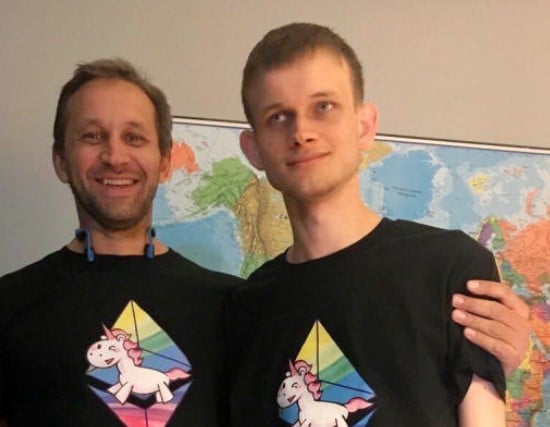
Vitalik Buterin with his father
- Buterin often contributes to several open-source software projects as a developer. He has worked on DarkWallet by Cody Wilson, Bitcoin Python libraries, and the cryptocurrency marketplace site Egora.
- In 2018, he donated $2.4 million of Ether to the SENS Research Foundation for research on rejuvenation biotechnologies and human life extension.
- In 2018, Buterin retweeted economist Glen Weyl’s tweet on the proposal for a new wealth tax. Soon, they became friends.
- Thereafter, Buterin and Glen Weyl co-authored a manifesto titled Liberation Through Radical Decentralization. It stated Buterin’s work on cryptocurrencies and Weyl’s work on market-based solutions to social issues.
- In 2019, Buterin worked with Zoe Hitzig, a PhD student at Harvard, and published a paper titled A Flexible Design for Funding Public Goods.
- The paper presented a method for efficiently providing public goods and utilizing a form of quadratic voting.
- In 2020, Buterin donated $50,000 to the SENS Research Foundation.
- In 2020, Buterin expressed his thankfulness for working on the Ethereum Project. He highlighted the interdisciplinary nature of the industry. He appreciated the opportunity to interact with leading cryptographers, mathematicians, and economists.
- In 2021, Buterin donated $1.14 billion worth of SHIBA coins to India’s Crypto Covid relief fund. This donation represented 5% of the coin’s circulation and led to a 50% drop in its price.
- In 2021, he donated $336 million worth of Dogelon Mars ($ELON) to the Methuselah Foundation, which aims to extend the human lifespan. This caused a 70% drop in the coin’s value.
- In 2022, during the Russian invasion of Ukraine, Buterin supported Ukraine and stated “Ethereum is neutral, but I am not.” He said that the attack was a crime against both the Ukrainian and Russian peoples.
- He then criticized Russia Today TV channel editor-in-chief Margarita Simonyan for claiming that those ashamed to be Russians due to Moscow’s actions were not truly Russian.
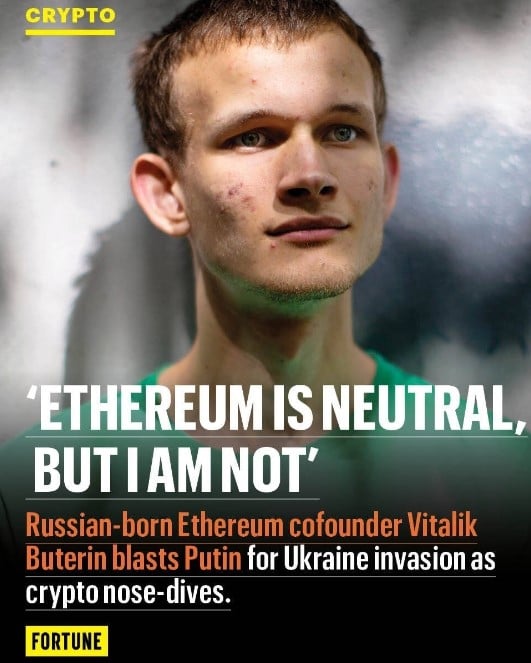
Vitalik Buterin’s statement on the Russian invasion of Ukraine
- In 2022, Vitalik Buterin released his book “Proof of Stake: The Making of Ethereum and the Philosophy of Blockchains,” published by Seven Stories Press.
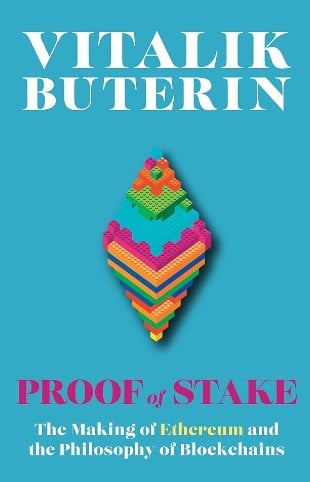
The cover of the book Proof of Stake The Making of Ethereum and the Philosophy of Blockchains
newspaper Recent News
Recent news and updates about Vitalik Buterin will appear here.
Similar Celebrities
VIEW ALLMedha Patkar
Social activist • Indian
Arpit Bala
YouTuber, Rapper • Indian
Simran Kaur Mundi
Actress, Model • Indian
Akasa Singh (Singer)
Singer, Actor • Indian
Sourabh Yadav
Singer, YouTuber • Indian
Firoz Khan (Amitabh)
Actor • Indian
Arber Hajdari
Executive Director Fundjave Ndryshe Foundation • Albanian
Carrie Fisher
Actress, screenwriter, author, producer, humorist • American
Abhishek Ghosalkar
Politician, Businessman, Digital Creator, Social Activist • Indian
Velmurugan (Bigg Boss 4 Tamil)
Playback Singer, Actor, and Lyricist • Indian