Dev Anand
Height
in centimeters- 173 cm in meters- 1.73 m in feet & inches- 5’ 8”
Age
88
Nation
• British Indian (1923-1947) • Indian (1947-2011)
favorite Personal Life
Basic Information
Family & Relationships
Education
Lifestyle
person_book Biography
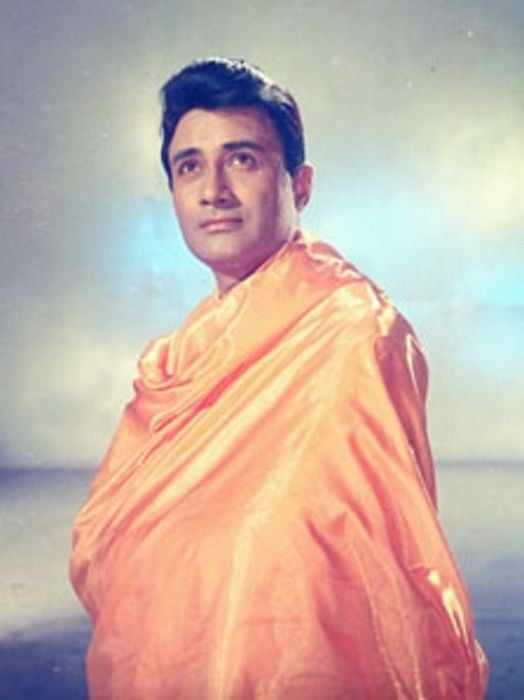
Some Lesser Known Facts About Dev Anand
- Dev Anand was an Indian actor, director, and producer who made significant contributions to Hindi cinema. His distinct style of dialogue delivery, characterized by rapid-fire delivery and a signature nod, endeared him to audiences across the country. He was renowned for his iconic performances in films like Roop Ki Rani Choron Ka Raja’ (1993), ‘Jewel Thief’ (1967), ‘Johny Mera Naam’ (1970), ‘Haré Rama Haré Krishna’ (1971), and many more.
- Dev Anand belonged to an upper-middle-class Punjabi Hindu family in Gurdaspur, Punjab.
- He was affectionately called D. D. by his schoolmates.
- According to some sources, he had a strong desire to pursue higher education in English, but his father’s financial difficulties prevented him from doing so. He wanted to join the Royal Indian Navy of the British Armed Forces, but he got rejected. In the early 1940s, he left his hometown and went to Bombay. Initially, he worked at the military censor’s office in Churchgate, earning a monthly salary of Rs. 65. Later, he secured a job as a clerk at an accounting firm, where he earned a higher salary of Rs. 85.
- Dev Anand decided to become an actor when he saw Ashok Kumar’s ‘Achhut Kanya’ and ‘Kismet’ as he was really impressed by Ashok’s performance in the films. Interestingly, Ashok Kumar selected Dev Anand for the film Ziddi, which was the first film starring Dev Anand as a protagonist.
- In an interview, Dev Anand recounted how he landed his first break in the film industry with the help of P. L. Santoshi. Dev initially tried to meet with Baburao Pai, an Indian filmmaker, at a studio, but he was turned away by the watchman. Baburao Pai, however, spotted Dev waiting outside and invited him into the office. He then arranged for Dev to meet with a director who was scheduled to visit the studio in two days. When Dev arrived for the meeting, he discovered that it was none other than P. L. Santoshi whom Baburao wanted him to meet. Following this, Dev was selected to play the role of ‘Shankar’ in the film ‘Hum Ek Hain’ (1946).
- In 1949, Dev Anand co-founded a production company named ‘Navketan Films’ along with his elder brother Chetan Anand. Yash Johar, the father of Indian filmmaker Karan Johar, initially worked as the production controller for Navketan Films and later went on to become a renowned filmmaker of Hindi cinema.
- In the early days of his career, Dev reportedly earned a modest sum of 365 rupees per film. He managed to buy his first car, Hillman Minx, after his debut film ‘Hum Ek Hain’ (1946).
- Dev Anand and Guru Dutt shared a warm relationship that was well-known in the Indian film industry. They had decided that all films directed by Guru Dutt would have Dev Anand as the protagonist and all movies produced by Dev Anand would be directed by Guru Dutt.
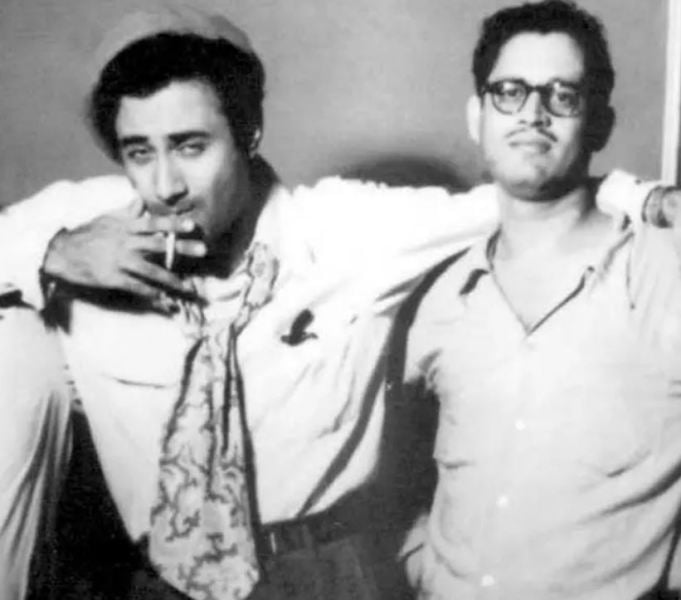
Dev Anand and Guru Dutt (right)
- Dev Anand wanted to cast Mumtaz in his film titled ‘Haré Rama Haré Krishna’ (1971), but Mumtaz had already signed seven films for the year. Due to an existing restriction at the time, actors were not allowed to sign more than seven movies in a year; however, Dev Anand was determined to have Mumtaz star in his film for he went to great lengths to make it happen. Despite facing opposition, he managed to secure police protection and took Mumtaz to Nepal, where they shot the film. Several actresses were offered the role of Dev Anand’s sister in the film Haré Rama Haré Krishna, but all of them refused to play the part. Later, the role was taken up by Zeenat Aman.
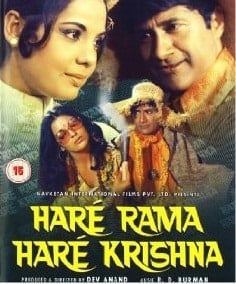
A poster of the film ‘Haré Rama Haré Krishna’ (1971)
- In an incredible twist of fate, a father found his long-lost child through the film ‘Haré Rama Haré Krishna’ after spotting her in one of the songs. He then contacted the filmmakers and was able to reunite with his daughter.
- Dev Anand developed feelings for Zeenat Aman while working on numerous films together. He planned to confess his love to her on the rooftop of The Taj Hotel after a party; however, witnessing a connection between Zeenat and Raj Kapoor at the party changed everything for Dev. The rumours regarding the closeness of Zeenat to Raj Kapoor during the making of the film ‘Satyam Shivam Sundaram’ (1978) only deepened Dev’s suspicions about their relationship. While writing about his affection for Zeenat Aman in his autobiography, Romancing With Life (2007), Dev Anand wrote,
Whenever and wherever she was talked about glowingly, I loved it; and whenever and wherever I was discussed in the same vein, she was jubilant. In the subconscious, we had become emotionally attached to each other. Suddenly, one day I felt I was desperately in love with Zeenat – and wanted to say so to her! To make an honest confession, at a very special, exclusive place meant for romance. I chose the Rendezvous at the Taj, on top of the city, where we had dined together once earlier. A drunken Raj Kapoor threw his arms around her exuberantly. This suddenly struck me as a little too familiar. And the way she reciprocated his embrace seemed much more than just polite and courteous. The hearsay now started ringing true. My heart was bleeding. In drunken joviality Raj told Zeenat: ‘You are breaking your promise that you will always be seen by me only in a white sari. More embarrassment was written large on her face, and Zeenat was not the same Zeenat for me any more. My heart broke into pieces… The rendezvous had already lost all meaning in my mind. I sneaked out of the place.” [3]Hindustan Times

Dev Anand and Zeenat Aman
- Dev Anand was banned to wear a Black suit after working in the film ‘Kala Pani’ (1958). According to reports, his popularity among his female fans in the early days of his career was so intense that a girl, who was mesmerised by his looks, allegedly ended her life. It is further claimed that some young girls even resorted to jumping off buildings just to catch a glimpse of him.
- Dev Anand worked in a Hollywood movie, ‘The Evil Within’ (1970).
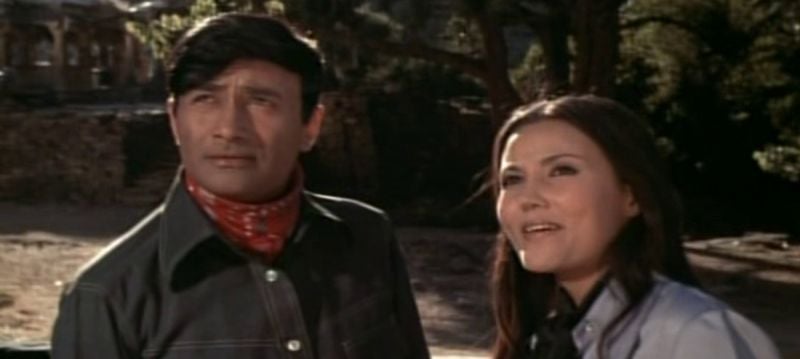
Dev Anand with Vietnamese-American actress Kieu Chinh in a still from the film ‘The Evil Within’ (1970)
- Dev Anand was the first choice for the films ‘Junglee’ (1961) and ‘Teesri Manzil’ (1966); however, he turned down both offers due to some unknown reasons. His loss eventually became Shammi Kapoor’s gain as Shammi accepted both films, which later proved to be a huge commercial success. In a similar instance, he refused the offer for the 1973 cult classic ‘Zanjeer,’ which later went to Amitabh Bachchan.
- In addition to creating timeless classics, Dev Anand played a crucial role in launching the careers of several prominent stars. Notable examples include Shatrughan Sinha, who got his big break from the film ‘Prem Pujari’ (1970); Zeenat Aman, who became a star after her performance in the film ‘Haré Rama Haré Krishna’ (1971); Jackie Shroff, who made his debut with the film ‘Heera Panna’ (1973); Zarina Wahab, who rose to fame with ‘Ishq Ishq Ishq’ (1974); Tina Ambani, who earned recognition for her role in the film ‘Des Pardes’ (1978); and Tabu, who received her initial break in the film ‘Hum Naujawan’ (1985).
- Dev Anand and actress Suraiya fell in love during the shooting of the film ‘Vidya’ (1948). The song ‘Kinare Kinare Chale Jayenge’ from the film had a pivotal moment when Suraiya fell from a boat, and Dev came to save her. Smitten by her, Dev Anand proposed to her with a diamond ring worth Rs. 3000; however, Suraiya was unable to accept the proposal because of her maternal grandmother’s objection to her marrying out of her religion, and as a result, she remained single until her death. In an interview, Dev talked about the engagement ring that he had given to Suraiya and revealed that Suraiya’s grandmother threw it into a river. Some sources claim that Suraiya even planned to elope with Dev Anand, but her grandmother found out about it, and Suraiya had to drop the plan. After the film ‘Do Sitare’ (1951), the pair did not share the screen again. In an interview, Dev Anand opened up about the bittersweet end of his first love story with Suraiya, reminiscing about the moments that brought them together and the circumstances that tore them apart and said,
It was destined that way. Had I gone to her, my life would have been different. Had I married her, life at her end would have taken me to a different course. Then may be I would not have been the Dev Anand I am today. I fell in love for the first time. We all know what first love does to a human being. Then the agony of not getting it. Suddenly hope was aroused after being encouraged, but again disillusionment crept in when nothing happened.”
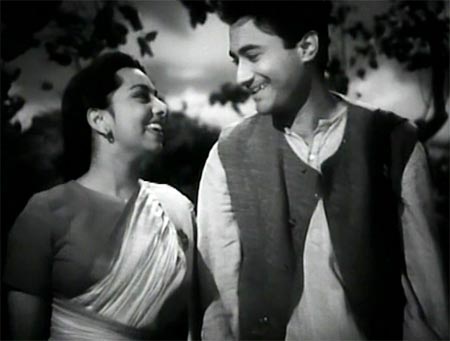
Dev Anand with Suraiya
- During his successful partnership with Suraiya, which brought forth hits like Vidya (1948), Jeet (1949), Shair (1949), Afsar (1950), Nili (1950), Do Sitare (1951), and Sanam (1951), the actress was often given top billing in the film credits and was considered a bigger star than the hero. Despite the success of their collaboration, Dev began to look for solo roles to establish his own stardom and prove his versatility as an actor.
- Dev Anand worked only in one film which had more than one lead actor.
- He never worked alongside megastar Amitabh Bachchan.
- Dev Anand was an ardent fan of Charlie Chaplin. On one fortunate occasion, he had the opportunity to meet his idol in Switzerland. During the meeting, Dev Anand couldn’t contain his excitement and repeatedly screamed “Hail Charlie” while raising his arms similar to how Nazi soldiers used to do.
- According to Dev’s son, Suneil Anand, Dev Anand shared a close bond with the American actor Kirk Douglas and the Italian-American director Frank Capra.
- The film ‘Guide’ (1965) marked a unique moment in Dev Anand’s illustrious career as it was the only movie in which his character died in the end.
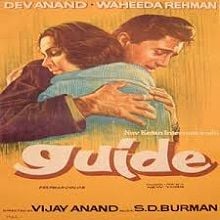
A poster of the film ‘Guide’ (1965)
- Dev Anand was not only a successful actor but also had an interest in politics. He actively campaigned against the internal emergency (25 June 1975 to 21 March 1977) alongside other prominent film actors. In addition, he established a political party called the ‘National Party of India’ (NPI), but he disbanded it after a few years.
- The Fredrick Hotel in Mahabaleshwar, a scenic hill station in Maharashtra, reserved room number 11 for Dev Anand. This particular room was exclusively kept for him, and he would stay there every time he visited the town.
- Dev Anand never worked in a television commercial in his entire career.
- He loved collecting jackets and had a collection of over 800 jackets.
- Dev Anand had a particular fondness for soft lighting in his workspace, which was none other than the penthouse atop his dubbing studio, Anand Recording Studio, located at 42, Pali Hill, Bandra.
- Dev Anand’s dashing looks often drew comparisons with the Hollywood heartthrob Gregory Peck, yet the Indian actor himself did not relish such comparisons. In an interview, Dev talked about this and said,
When you are at an impressionable age you make idols, but when you grow out of the phase, you develop your own persona. I don’t want to be known as India’s Gregory Peck, I am Dev Anand.”
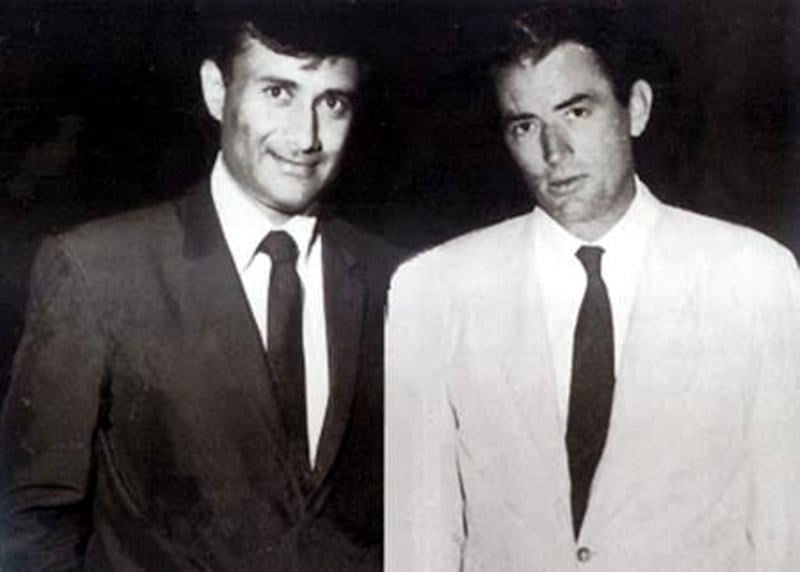
Dev Anand and Gregory Peck
- Dev Anand was one of the three most celebrated actors in the Indian film industry along with Raj Kapoor and Dilip Kumar who were commonly known as ‘Trinity – The Golden Trio.’
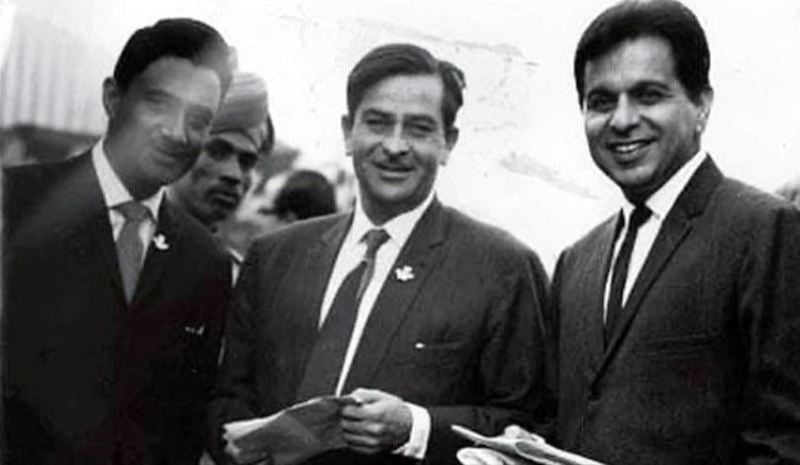
Dev Anand (left) with Raj Kapoor (centre) and Dilip Kumar (right)
-
Throughout his career, Dev Anand was bestowed with various titles, including ‘Evergreen Star’ and ‘Dev Saab,’ among others.
- In 2007, he chronicled his experiences in his autobiography, ‘ Romancing with Life.’ In this memoir, Dev Anand shared his failures, achievements, and the lessons he learned throughout his life. His book is a treasure trove of personal anecdotes, including his unsuccessful love story with Suraiya, his obsession with Zeenat Aman, and his eventual finding of true love with Kalpana Kartik.
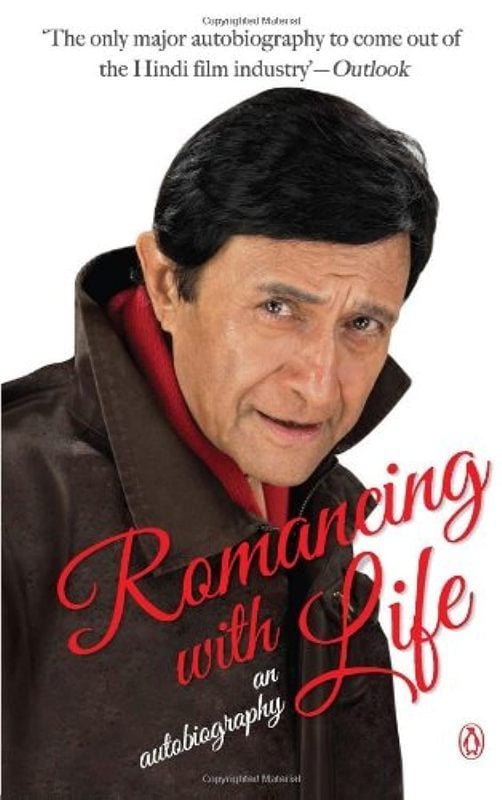
Dev Anand’s ‘Romancing with Life’ (2007)
- Dev Anand, 88, died of cardiac arrest in his room at The Washington Mayfair Hotel in London on 3 December 2011. A week later, i.e., on 10 December 2011, a funeral service was held at a small chapel. The coffin was then taken to the Putney Vale Crematorium in southwest London, where the final rites were performed. His ashes were later brought to India, where they were immersed in the holy waters of the Godavari River.
newspaper Recent News
Recent news and updates about Dev Anand will appear here.
Similar Celebrities
VIEW ALLLata Mangeshkar
Playback Singer, Music Composer, Film Producer • Indian
Harsh Dingwani
Actor Choreographer • Indian
Harsh Khurana
Actor, Writer • Indian
Alam Lohar
Punjabi folk singer, poet, and musician • Pakistani
Vikram Jadhav
Fitness Coach, Fitness Model • Indian
Ritu Shivpuri (Actress)
Actress, Jewellery Designer • India
Tina Shilparaj
Actress • Indian
Riddhi Kumar
Model, Actor • Indian
Rajeev Pillai
Actor, Model, Cricketer, Dentist • Indian
Isabela Merced
Actress, Voice Actress, Singer, Songwriter, Dancer, Ukulele Player • American, Peruvian