Alam Lohar
Age
51
Nation
Pakistani
favorite Personal Life
Basic Information
Family & Relationships
person_book Biography
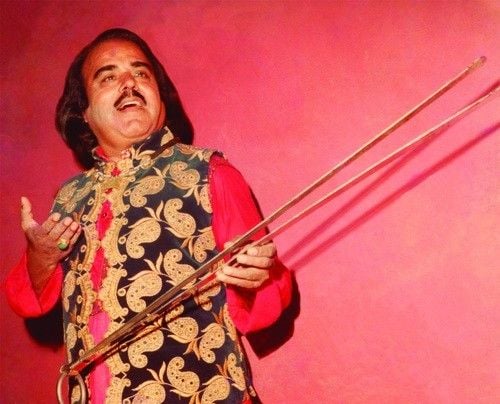 Some Lesser Known Facts About Alam Lohar
- He started learning music at the age of 13.
- He was born into a family of blacksmiths. As a child, Lohar read Sufiana Kalaam, a collection of Punjabi stories, and poetry.
- His family and children now live all around the world with most of his children in the UK.
- In his childhood, he uses to read Sufi Poetry (Sufiana Kalaam), Punjabi folk stories and participated as a young child in local gatherings expressing a vocal-only art form in reading passages of great poets.
- He was a great singer that influenced his audience with elements of joy, peace, happiness, and sadness.
- In 1970, he started going to festivals and gatherings on a regular basis and with these performances, he became one of the most listened to singers in South Asia.
- He is popularly known for his performance of Sufi poet Waris Shah’s Heer, along with other songs like Saif-Ul-Malook.
- He sang various famous long plays (LP) like Jugni (1965), Saif ul Mulook (1948), Qissa Yusuf Zulaykha (1961), Bol Mitti de Bawa (1964), and Dilwala Dukhra (1975) and achieved 15 Gold Disc LP’s (record sales) for them.
- In the early ’70s, he became one of the most listened to singers in South Asia.
- He toured different countries like United Kingdom, Canada, Norway, United States, and Germany for the South Asian communities (1970).
- He established his own musical and theatre group.
- Alam’s various songs such as Jugni, Dilwala Dukhra, Waja Mariyan, and many others are still loved by his millions of fans.
- His instrument of choice was “Chimta,” and no other singer in Pakistan had ever used the instrument before Alam Lohar. He popularised Chimta in Pakistan, and the instrument has been used by Pakistani musicians ever since. The instrument is a featured instrument in the Pakistani folk music industry.
- He also sang romance ballads like Sassi Pannu and Sohni Mahiwal.
- Alam recorded 36 renditions of Waris Shah’s Heer Ranjha in various styles and forms.
- In 1979, his life came to an unfortunate end when a truck collided with his vehicle. He was buried on the outskirts of the town of Lalamusa.
- His son, Arif Lohar, established Alam Lohar’s Memorial Trust, along with his brothers, in memory of his father.
- In 2016, Arif announced that he would make his father’s biopic. [4]The Tribune
- Alam recorded hundreds of albums and recordings. He was a man with a wide smile and deep love for his culture.
- In memory of Alam, the Government of Pakistan named a road after him, which runs from his birth village (Aach) to the main Grand Truck Road signed as ‘Alam Lohar Road’.
newspaper Recent News
Recent news and updates about Alam Lohar will appear here.
Similar Celebrities
VIEW ALLAtul Parchure
Actor • Indian
Tanu Chandel
Model, Actress • Indian
Shruti Ulfat
Actress • Indian
Abijeet Duddala (Bigg Boss Telugu 4)
Actor • Indian
Adnan Sajid Khan
Actor • Indian
Mushtaq Khan
Actor • Indian
Rajiv Kapoor
Actor, Producer, and Director • Indian
Sucha Yaar
Singer, Lyricist, and Model • Indian
Manchu Vishnu (Actor)
Actor, Director, Producer, Educationalist, Philanthropist, Entrepreneur • Indian
Allu Sirish
Actor • Indian