Edi Rama
Height
6' 7" (201 cm)
Age
61
Nation
Albanian
favorite Personal Life
Basic Information
Family & Relationships
Education
Lifestyle
person_book Biography
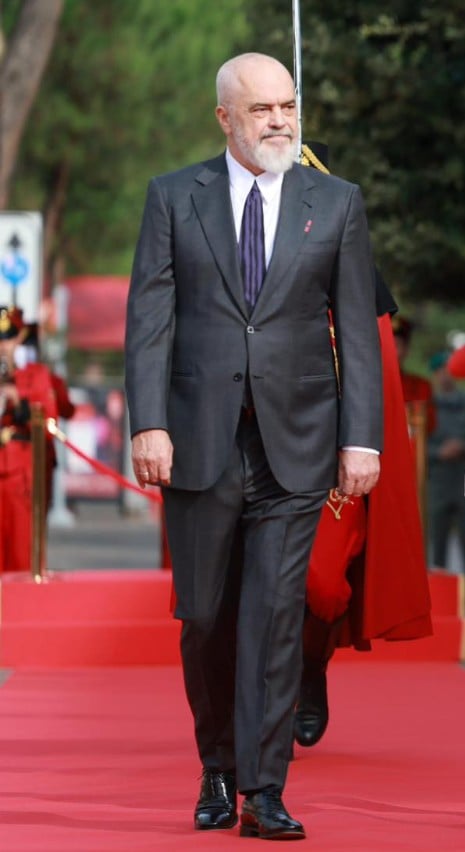
Some Lesser Known Facts About Edi Rama
-
His father was born in Durrës and worked as a sculptor. He made statues in Albania during the communist period.
-
He was associated with the communist government and took part in signing the death sentence for opposition poet Havzi Nela in 1988.
-
His great-grandfather, also named Kristaq Rama, worked for Albanian independence and better schools.
-
The family originally came from Berat, but later moved to Durrës.
-
His paternal family members belong to Dardhë, a village in the southeast near Korçë.
-
His mother, Aneta Rama, belonged to a village in Vlorë and was a doctor. She was the great-niece of Spiro Koleka, who was a member of the ruling party during Communist times.
-
Rama once claimed that the Koleka family’s ancestors came from Mirdita in the north, and the family name comes from Kol Leka.
- As a child, Rama was baptised as a Catholic and identifies with the Catholic Church. Later, he described himself as agnostic. He said that he did not follow any specific faith and believed that the existence of God is beyond human understanding.
-
When he was a child, Rama started learning painting.
-
Edi Hila and Danish Jukniu, two well-known Albanian painters, recognised his talent when he was a teenager and motivated him to improve his art skills.
-
After that, he went to the Jordan Misja Artistic Lyceum, an art school in Tirana, and finished his studies there.
-
As a teenager, Rama was a national basketball player and was part of the Albania national team. He played basketball for Dinamo Tirana. Later, he took up basketball as a hobby.
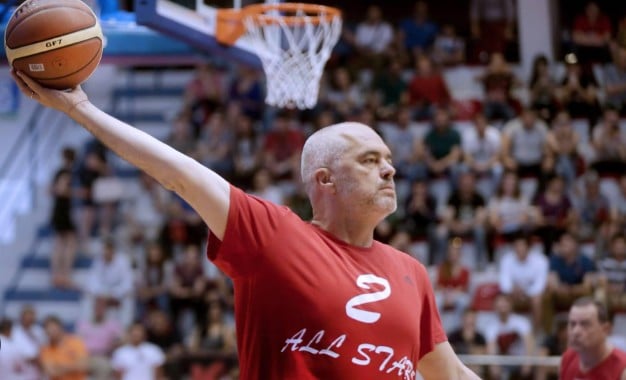
Edi Rama while playing basketball
-
In 1982, he joined the Academy of Arts in Tirana and started working as a teacher.
-
There, he led student meetings that criticised the communist government.
-
In 1992, his writings from these meetings were published in a book titled Refleksione.
-
When communism ended in Albania, he tried to join the fight for democracy, wanted to help student protests, and become a member of the new Democratic Party, but left when he disagreed with Sali Berisha.
-
In 1994, Rama moved to France from Albania and started working as a painter. He displayed his artwork in several galleries with his former student, Anri Sala.
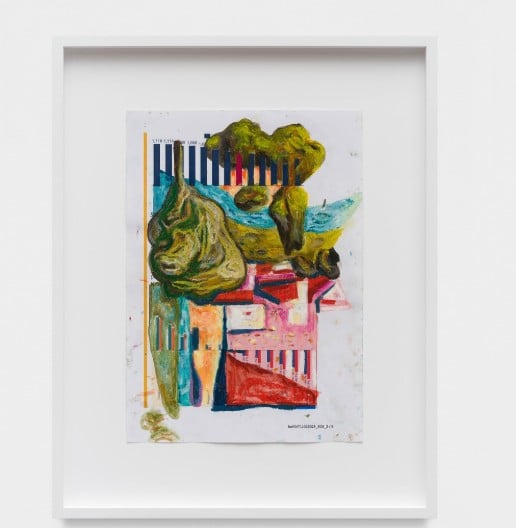
A painting by Edi Rama
-
In January 1997, Rama was attacked in Albania. It was reported that the State Secret Service might have been involved because Rama often criticised the Albanian government.
-
In 1998, he returned to Albania for his father’s funeral. After that, the Prime Minister, Fatos Nano, offered him a government job.
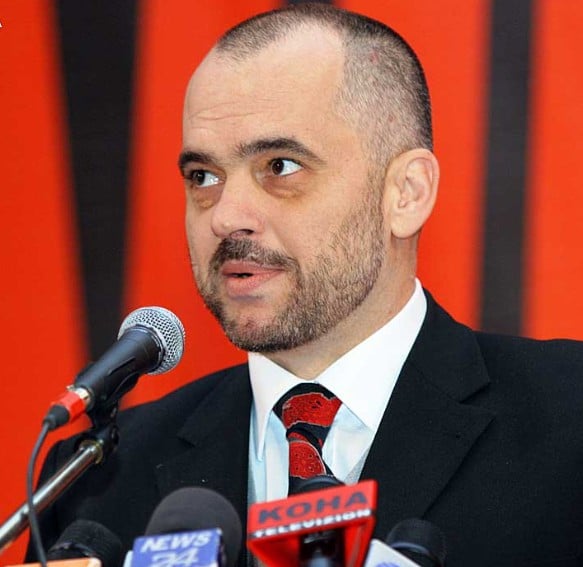
An old picture of Edi Rama
-
He was appointed as the Minister of Culture, Youth, and Sports.
-
As minister, he was noted for wearing bright clothes and for trying new ideas in cultural projects.
-
He became popular for cultural work, strong opinions, and colourful style helped him become popular.
- In 2000, Edi Rama contested the mayoral elections as an independent.
-
In October 2000, he was elected as Mayor of Tirana on the ticket of the Socialist Party. He won with 57% of the votes and defeated his opponent, Besnik Mustafaj, a writer and diplomat.
-
After becoming the Mayor, he removed illegal buildings and restored many parts of the city.
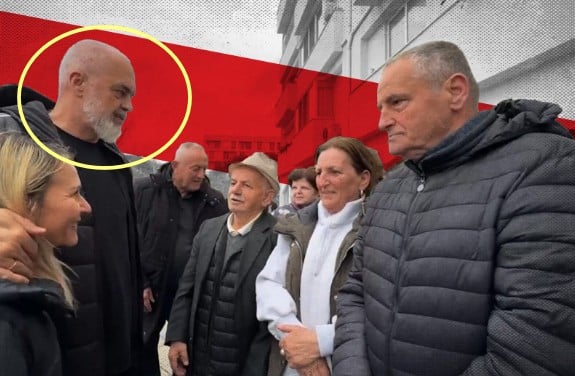
Edi Rama while working as a Mayor of Tirana
- On 27 November 2002, Rama officially changed his first name from Edvin to Edi.
-
In 2002, when the Socialist Party lost the parliamentary elections, opposition leader Fatos Nano quit as leader. Rama contested for the position and won. He defeated opposition leader Rexhep Meidani.
-
Rama used his popularity and position to help the Socialist Party become stronger. He replaced many old leaders with his younger supporters.
-
Edi Rama presented himself as an outsider politician. He was inspired by Tony Blair’s ‘New Labour’ and Anthony Giddens’ ‘Third Way’ ideas.
- He was reelected as mayor in 2003 and 2007. In 2007, the Socialist Movement for Integration (SMI) supported him to become the Mayor again.
-
In 2004, Rama started repainting old apartment blocks with bright colours in Tirana.
-
That same year, he was awarded the World Mayor Prize for making new roads, parks, planting thousands of trees, and promoting cultural life. He created the Tirana City Master Plan and improved Skanderbeg Square.
-
He worked on modernising local government and helping leaders.
-
In 2008, during his tenure in opposition, he supported changes made to Albania’s election law, such as limiting the President’s powers.
-
These changes were opposed by the President and other parties, but they passed with a large majority.
-
That same year, when the Socialist Party’s election law changes were implemented, Ilir Meta and the SMI viewed these reforms as harmful to their party and did not join Rama for the 2009 elections.
-
In 2009, the Socialist Party, led by Rama, won 66 seats, but Prime Minister Berisha’s Democratic Party won 70 seats. SMI got 4 seats and supported Berisha.
-
Rama requested for vote recount, but the courts denied it.
-
After losing elections, Rama kept working as a Socialist Party leader. The party boycotted Parliament for months and held a hunger strike to get attention.
- In October 2012, he shared his photo with Barack Obama at a fundraising event on Facebook and Twitter before Albania’s 2013 election. He shared his connection with the U.S.; however, Rama’s ticket was bought for $80,000 by intermediaries who later pleaded guilty to illegal foreign contributions linked to the 2012 U.S. presidential election.
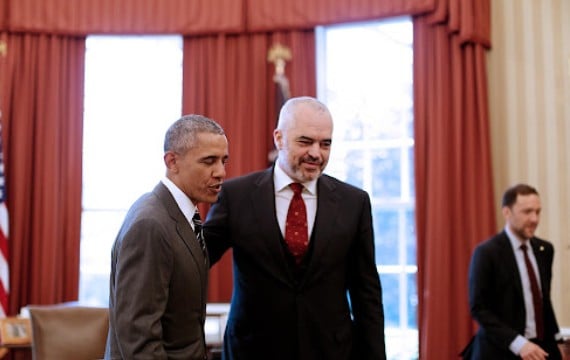
Edi Rama with Barack Obama
-
In 2013, Edi Rama led the Socialist Party and its coalition, including the Socialist Movement for Integration (SMI), to a big win in the parliamentary elections.
-
In the elections, he defeated Prime Minister Sali Berisha’s coalition.
-
His political campaign, titled ‘Renaissance,’ focused on four main goals: joining the European Union, advancing the economy, reforming law and order, and making state institutions more democratic.
-
In September 2013, Rama became the 33rd Prime Minister of Albania.
-
Edi Rama said during the 2013 campaign that improving public order was his primary focus.
-
At that time, the Albanian police covered only about 55% of the country’s population.
-
On 11 September 2013, his first cabinet was sworn in by President Bujar Nishani.
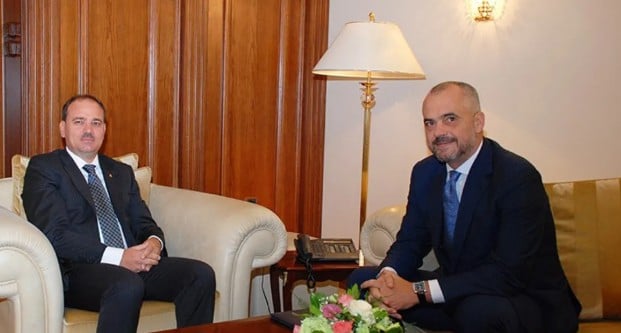
Edi Rama with Bujar Nishani
-
His cabinet had 21 members, 15 ministers from the Socialist Party and 6 from the Socialist Movement for Integration (SMI).
- His ministers included Niko Peleshi as Deputy Prime Minister, Mimi Kodheli as Minister of Defence, Saimir Tahiri as Minister of Interior, Ditmir Bushati as Minister of Foreign Affairs, Nasip Naço as Minister of Justice, and Klajda Gjosha from SMI as Minister of European Integration.
-
After that, his government invested in modernising the police, improving training, and increasing their salaries. Later, the police received praise for a successful drug raid in Lazarat, a village known for narcotics production.
-
Edi Rama became known for improving Albania’s corrupt and weak judicial system.
-
Between 2013 and 2025, Rama implemented many reforms in Albania, including changes to the administration, social welfare, pensions, and higher education.
-
He then pursued a historic reconciliation policy between Albanians and Serbs.
-
In 2013, Edi Rama developed a strong personal relationship with President Recep Tayyip Erdoğan and regarded Turkey as a key strategic partner.
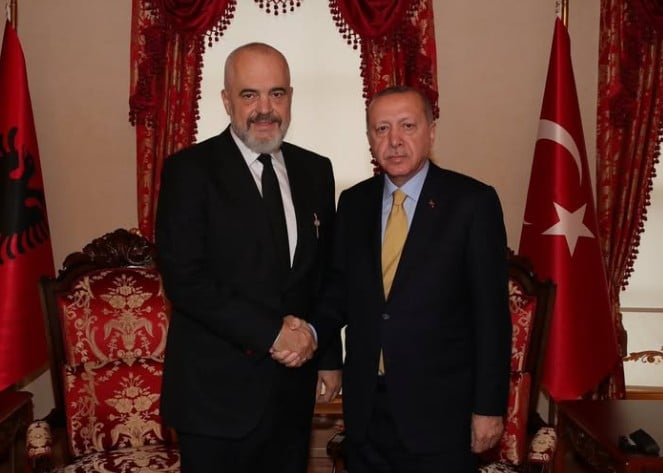
Edi Rama with President Recep Tayyip Erdoğan
-
Rama has supported shutting down schools linked to the Gülen movement, which he called a ‘terrorist organisation’.
-
He has led many high-level meetings with leaders from Germany, the US, France, the UK, China, Austria, and Israel.
-
In 2014, he visited Belgrade and became the first Albanian Prime Minister to do this in more than 70 years. During this visit, he compared the Albanian-Serbian reconciliation with the post-World War II French-German reconciliation.
-
Edi Rama supports the Berlin Process, which promotes cooperation between the European Union and Western Balkan countries.
- In 2015, while speaking to the public in Israel, he praised his country, Albania, for protecting Jewish families during the Holocaust and signed agreements with Israel for medical research cooperation.
-
In 2016, Parliament passed a law that removed judges or prosecutors who could not explain their wealth or previous suspicious decisions.
-
Rama’s government repaired the energy sector and collected unpaid bills, and invested in upgrading the power grid.
-
Albania’s economy grew from 0.5% in 2013 to over 4% by 2017. The unemployment level dropped, and about 183,000 new jobs were created.
-
In 2017, his Socialist Party won the parliamentary elections with a majority.
-
In his government, Rama follows a neo-liberal economic policy that cuts public spending and encourages partnerships between the government and private businesses in sectors like tourism, education, health, culture, and public works.
-
The International Monetary Fund (IMF) has warned that Albania was privatising too fast, which could risk the country’s finances.
-
In 2017 and 2018, the economic growth of the country reached 4%, and unemployment dropped from 17.5% in 2014 to 11.5% in 2020.
-
Edi Rama once claimed that economic improvements in the country were the result of political stability. However, reportedly, salaries remained low, and many people have been leaving the country since 2014.
-
During his tenure, drug trafficking increased, accounting for about one-third of Albania’s GDP in 2017.
-
Italian customs destroyed many cannabis plants, but this was only a small part of the total cultivation.
-
Saimir Tahiri, who served as the Minister of Interior from 2013 to 2017, was accused and sentenced for involvement in drug trafficking.
-
In September 2017, his 2nd Cabinet was sworn in by President Ilir Meta and was the 9th Cabinet of Albania. The cabinet had 15 members, all from the Socialist Party.
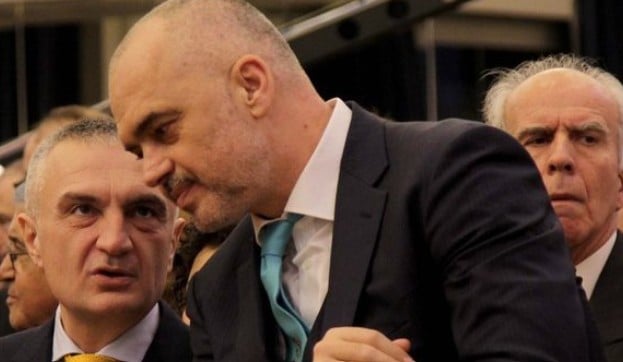
Edi Rama with President Ilir Meta
-
His ministers in this cabinet included Deputy Prime Ministers Senida Mesi and Erion Braçe, and ministers like Arben Ahmetaj (Finance), Olta Xhaçka (Defence), Etilda Gjonaj (Justice), and Ogerta Manastirliu (Health).
-
Edi Rama focused on increasing integration with the Western Balkans to stop conflicts and criticised the Russian influence in the region.
-
In 2018, Rama passed a law that allowed universities to compete and work according to market principles, but higher tuition fees upset many students.
-
In 2019, Rama disputed with Ramush Haradinaj, the Prime Minister of Kosovo, over the Open Balkan plan. He accused Haradinaj of lying and filed a defamation lawsuit in the following year.
-
During his tenure as a Prime Minister, the minimum wage in the country rose from 24,000 ALL in 2017 to 40,000 ALL (€404) in 2023, and public administration salaries increased to an average of €1040 by 2025.
- On 10 October 2019, Rama signed a regional cooperation deal, ‘Mini Schengen’, with Serbia and North Macedonia to promote free movement of goods, services, and people.
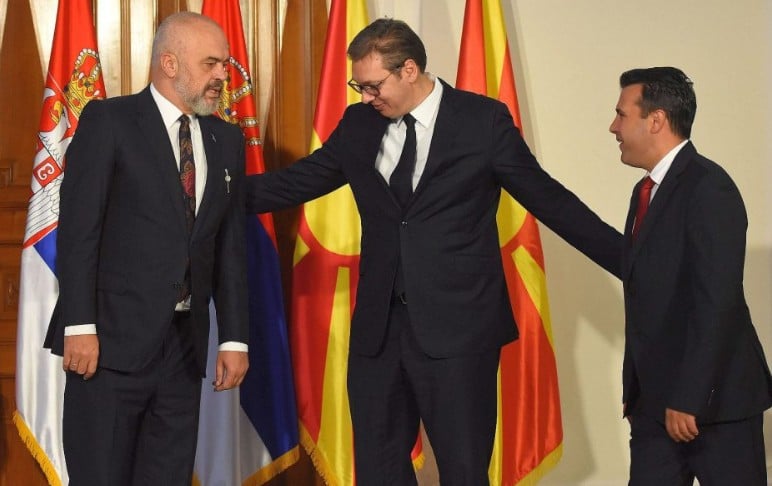
Edi Rama during the cooperation deal, ‘Mini Schengen,’ with Serbia and North Macedonia
- He supports the exchange of artificial intelligence, clean energy, and supply chain integration between the Western Balkans and the EU.
- Rama has invited EU investors to get the opportunities in the Western Balkans, so that he can increase the regional GDP.
-
On 26 November 2019, when an earthquake hit Albania, its parliament gave Rama emergency powers to handle the crisis.
-
Rama visited the worst-hit area to see the damage himself. He worked with his political opponents, Meta and Basha, on relief efforts.
-
On 30 November 2019, Edi Rama ended the search and rescue, and the next day attended the first funeral for victims.
- Under his leadership, by 2019, Albania had the fifth-lowest unemployment rate in the Balkans, Europe.
- His son, Gregor, from Rama’s first marriage, survived cancer. In 2019, his daughter-in-law died in the Albania earthquake.
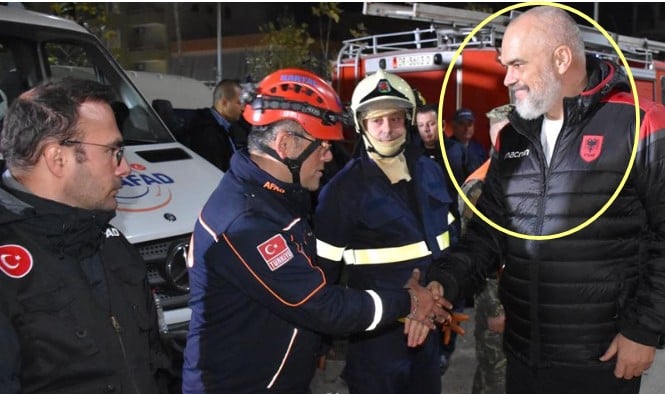
Edi Rama during his visit to the earthquake-hit areas in Albania (2019)
- In December 2019, his government issued laws to regulate online media. The laws gave power to the government to fine journalists and block content.
- The critics called the rule censorship that would harm independent news. After that, the Venice Commission found some defects in the rules, and Rama welcomed their suggestions to protect free speech.
-
In the 2020 state budget, he allowed financial support for rebuilding homes after the earthquake.
-
Rama asked for help from experts and financial aid from other countries. He claimed that Albania cannot rebuild alone.
-
In December 2020, some NGOs and media houses criticised Rama for using emergency powers to pass controversial laws when he asked parliament to extend his powers by three months.
-
After that, Edi Rama established a special group to manage donations from Albanians living abroad and ensure that the money was well utilised.
-
He talked with many world leaders and organised an international donors conference to raise recovery funds.
-
That same month, he attended a donors conference in Turkey, which was hosted by President Erdogan.
-
In January 2020, Rama shared the €1 billion damage estimates caused by the earthquake.
- In December 2021, Rama was removed from a Lufthansa flight after he refused to wear a mask as required by COVID-19 rules.
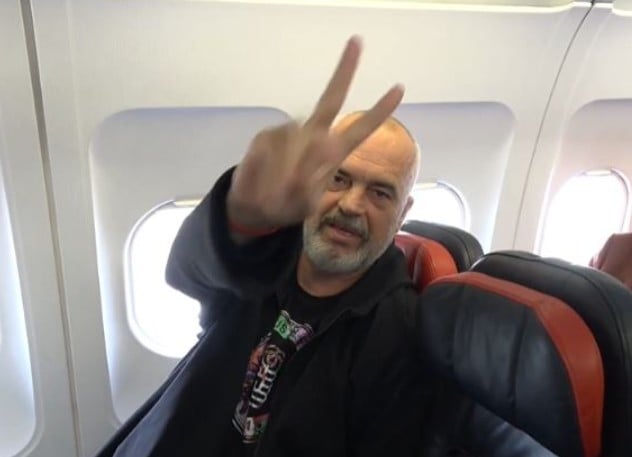
Edi Rama while showing a victory sign on a Lufthansa flight in 2021
- In 2024, Edi Rama said that he would set up a new European microstate, the Sovereign State of the Bektashi Order, within Tirana. It will be the headquarters for the Bektashi Order, a Sufi Islamic order.
- In 2025, Rama appointed an AI-generated character named Diella as a government minister to manage public tenders to fight corruption.
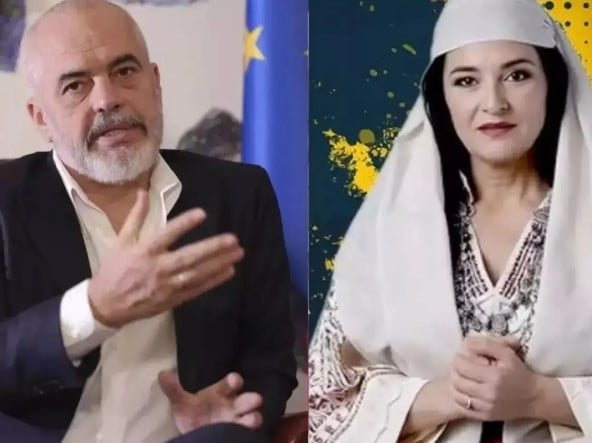
Edi Rama while appointing an AI-generated character named Diella as a government minister (2025)
- In June 2025, Rama condemned the UK’s asylum policies and received criticism for hypocrisy as he signed a similar agreement with Italy.
- He was also criticised for kneeling to welcome Italian Prime Minister Giorgia Meloni, which some viewed as a sign of Albanian subordination to Italy due to its historical occupation.
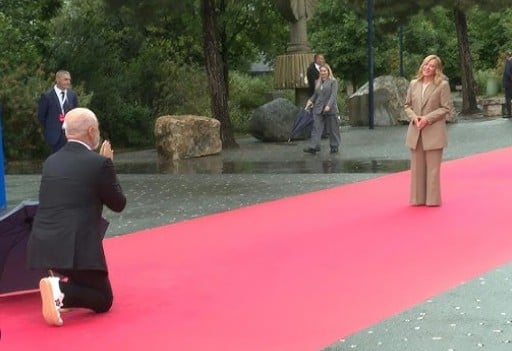
Edi Rama while welcoming Italian Prime Minister Giorgia Meloni
- Rama is fluent in Albanian, English, French, and Italian.
- He supports the sports teams FK Partizani (Tirana) and Juventus.
- Rama hosts a podcast called ‘Flasim,’ where he often invites noted guests like Ermonela Jaho and Ogerta Manastirliu.
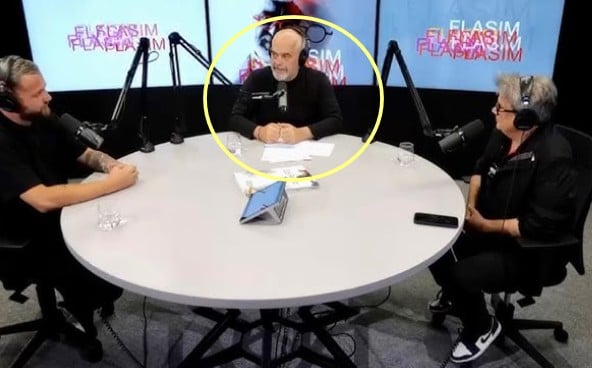
Edi Rama during his podcast ‘Flasim’
newspaper Recent News
Recent news and updates about Edi Rama will appear here.
Similar Celebrities
VIEW ALLSavitri Jindal
Businesswoman, Politician • Indian
Rao Inderjit Singh
Politician, Sport Shooter • Indian
Sampat Pal
Social Activist, Politician • Indian
Abhay Kumar Singh (Russia)
Entrepreneur, Politician • Russian
D. K. Suresh
Politician, Social Worker • Indian
Krishna Kumari (Pakistan)
Politician • Pakistani
Diya Kumari
Politician • Indian
Geet Grewal
Lawyer and Political Leader • Canadian
Kalyan Singh
Politician • Indian
Deepa Dasmunsi
Politician and Artist • Indian