Queen Mother Sirikit
Height
5' 6" (170 cm)
Age
93
Nation
Thai
favorite Personal Life
Basic Information
Family & Relationships
Education
Lifestyle
person_book Biography
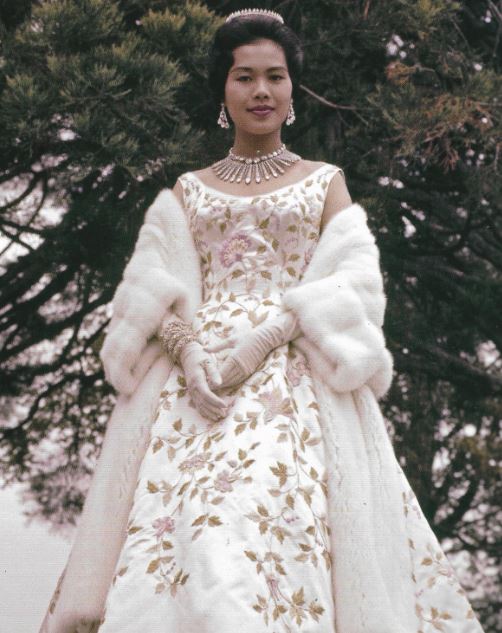
Some Lesser Known Facts About Queen Mother Sirikit
- Sirikit Kitiyakara was born into an aristocratic family closely connected to the Chakri dynasty.
- Her father, Prince Nakkhatra Mangkala Kitiyakara, was the Thai ambassador to several countries, and her mother, Mom Luang Bua Snidvongs, came from a noble family as well.
- Shortly after her birth, her father was posted to Washington, D.C., as Secretary of the Siamese Legation, and her mother joined him later.
- Sirikit stayed behind in Thailand with her grandparents for about a year before the family reunited and returned to Bangkok. They settled at Deves Palace, near the Chao Phraya River.
- Sirikit began her education at Rajini School (Queen’s College) in Bangkok and later moved to Saint Francis Xavier Convent School during World War II, when air raids made the city unsafe.
- In 1946, her father became Thailand’s ambassador to the Court of St. James’s in the United Kingdom.
- The family moved to London, and Sirikit continued her studies there. She later lived in Denmark and France, where she attended a music academy in Paris and learned piano and languages, becoming fluent in English and French.
- While living in Paris in the late 1940s, 16-year-old Sirikit met King Bhumibol Adulyadej, the young monarch of Thailand, who was studying in Switzerland.
- Both were descendants of King Chulalongkorn (Rama V). The two met frequently at the Thai Embassy in Paris and developed a close friendship.
- On 4 October 1948, King Bhumibol was seriously injured in a car accident near Lausanne, Switzerland. Sirikit visited him often at the hospital, and their bond deepened.
- With the encouragement of the King’s mother, Princess Srinagarindra, Sirikit enrolled at Riante Rive, a boarding school in Lausanne, so she could continue her studies nearby.
- Their engagement was announced on 19 July 1949, in Lausanne. The royal wedding took place on 28 April, 1950, at Srapathum Palace in Bangkok, just one week before King Bhumibol’s coronation.
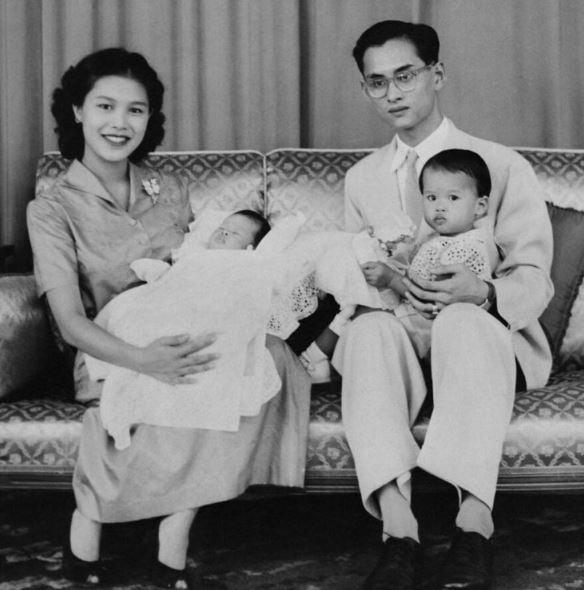
Queen Mother Sirikit a few years after marriage
- After their marriage, both received the Order of the Royal House of Chakri, and they later returned to Switzerland to continue their education. The couple returned to Thailand in 1952, marking the start of Sirikit’s life as queen consort.
- Together, they pledged to “reign with righteousness for the benefit and happiness of the Thai people.”
- In 1956, when King Bhumibol entered monkhood for a short period, Sirikit was appointed Queen Regent of Thailand, officially taking the oath at Ananta Samakhom Throne Hall on 20 September 1956.
- From then on, she was known as Somdet Phra Nang Chao Sirikit Phra Borommarachininat.
- During the 1950s and 1960s, the King and Queen travelled extensively around the world as goodwill ambassadors, meeting world leaders and strengthening Thailand’s international image.
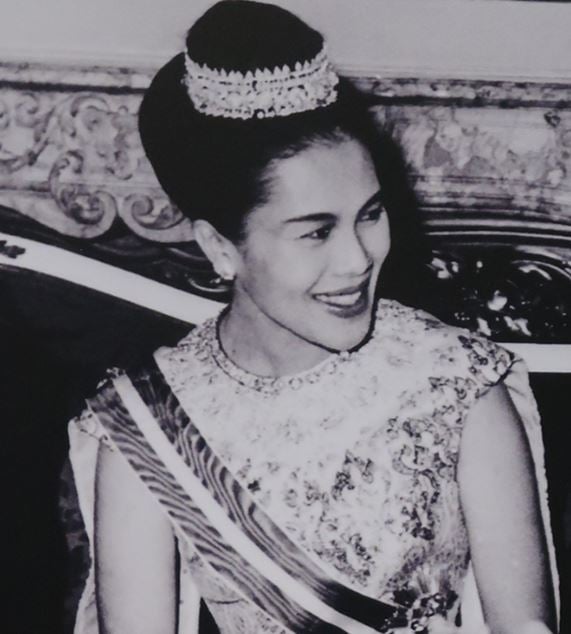
Queen Mother Sirikit in 1964
- However, by the 1970s, their focus shifted toward domestic development. Queen Sirikit began traveling with the King to Thailand’s remote provinces, where she witnessed poverty, malnutrition, and social struggles firsthand.
- Her compassion and direct engagement with villagers became one of her defining traits. She was often seen sitting among them, listening to their problems, from health issues to family conflicts.
- In a 1979 interview with the Associated Press, she explained her mission – “Misunderstandings arise between people in rural areas and the rich, so-called civilised people in Bangkok. People in rural Thailand say they are neglected, and we try to fill that gap by staying with them in remote areas.”
- In 1976, she founded the SUPPORT Foundation (Foundation for the Promotion of Supplementary Occupations and Related Techniques) to help rural villagers preserve traditional crafts like silk weaving, ceramics, jewellery-making, and painting.
- Thousands of rural women gained new livelihoods through this program. Sirikit was also passionate about environmental conservation.
- She established wildlife breeding centres, open zoos, and sea turtle hatcheries. Her projects, Forest Loves Water and Little House in the Forest, promoted reforestation and the protection of natural water resources, showing that conservation could also bring economic benefits.
- Her influence extended into humanitarian work as well. She became Honorary President of the Thai Red Cross Society in 1956 and played a vital role in relief efforts during crises such as the 2004 tsunami and the refugee movements from Cambodia and Myanmar.
- While Queen Sirikit was generally seen as a unifying and motherly figure, her rare public appearance at the 2008 funeral of a protester killed in political clashes drew attention and led some to interpret it as a subtle political stance during Thailand’s years of turmoil.
- Despite these controversies, her image remained one of grace, compassion, and cultural pride. Her portrait could be found in almost every Thai home, office, and public space.
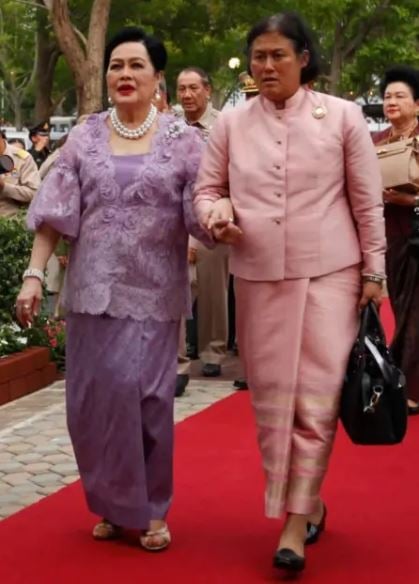
Queen Mother Sirikit (right) during a red carpet event
- Her birthday, August 12, was declared a national holiday in 1976 and is celebrated as Mother’s Day in Thailand.
- Throughout her reign, she received many national and international honours, including the Order of the Precious Crown (Japan), the Order of Merit of the Italian Republic, and the Order of Charles III (Spain).
- On 21 July 2012, Queen Sirikit suffered an ischemic stroke while exercising at Siriraj Hospital in Bangkok.
- She was hospitalized for a long period and gradually withdrew from public life.
- In November 2016, after her husband’s death, she was discharged to Chitralada Royal Villa, where she continued to recover privately under medical supervision.
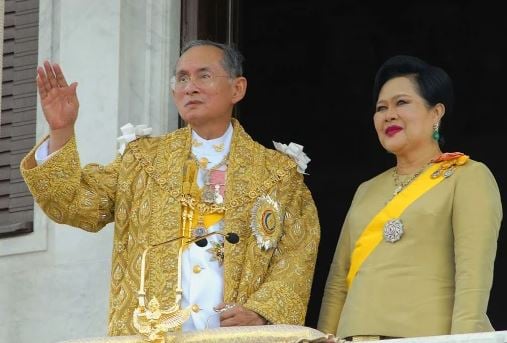
Queen Mother Sirikit with her deceased husband
- After years of declining health, Queen Mother Sirikit died on 24 October 2025, at King Chulalongkorn Memorial Hospital in Bangkok at 9:21 p.m.
- She was 93 years old. The Royal Household Bureau confirmed that she had suffered from a blood infection since 17 October and that, despite intensive medical treatment, her condition did not improve.
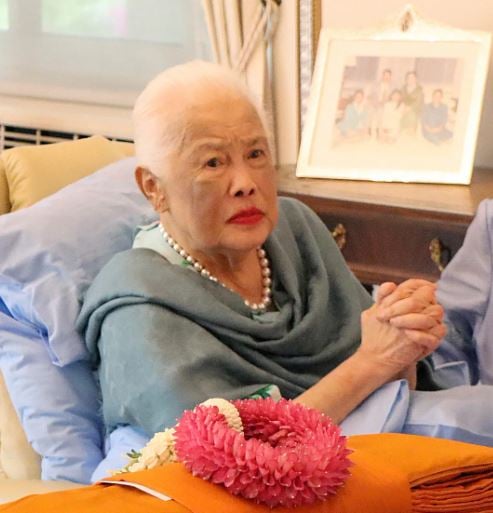
Queen Mother Sirikit during her last years
- King Maha Vajiralongkorn ordered a state funeral with the highest honours and declared a one-year mourning period for royal family members and palace staff.
- Prime Minister Anutin Charnvirakul announced that Thailand’s national flags would fly at half-staff for 30 days, and civil servants would also observe a year-long mourning period.
- Mourners began gathering outside the hospital as soon as the news broke. “It is yet again another great loss for the whole nation,” said Maneerat Laowalert, a 67-year-old Bangkok resident.
- “I heard about it at 4 a.m. I felt like fainting. The whole world seemed like it had stopped.” Although her later years were spent away from the public eye, Queen Sirikit’s influence on Thailand endured through her cultural, social, and environmental work.
- She was not only the longest-serving queen consort in the world but also a symbol of Thai identity, motherhood, and tradition.
- Her legacy continues through the institutions named after her, such as the Queen Sirikit National Convention Center, Queen Sirikit Park, and Queen Sirikit Botanic Garden, all reminders of a life devoted to her people.
- Her birthday, August 12, remains a national holiday and a celebration of all mothers across Thailand, a lasting tribute to the Queen Mother who devoted her life to the service and unity of her nation.
newspaper Recent News
Recent news and updates about Queen Mother Sirikit will appear here.
Similar Celebrities
VIEW ALLNimisha Bansal (Peyush Bansal’s
Indian
Saurabh Dwivedi
Journalist • Indian
Naina Yadav (News Anchor)
Journalist • Indian
The Great Indian
List of Hindi Dubbed Movies of Suriya (12)
Griha Atul (News Anchor)
Journalist • Indian
Agasthya Bose Roy (Ronit Roy’s Son)
Indian
Jyotsna Bedi
Journalist, News Anchor • Indian
Ummul Kher (Disabled UPSC 2016 rank holder)
Indian
Jaclyn Stapp
Jordanian