V. S. Achuthanandan
Height
5' 5" (165 cm)
Age
101
Nation
Indian
favorite Personal Life
Basic Information
Family & Relationships
Education
Lifestyle
person_book Biography
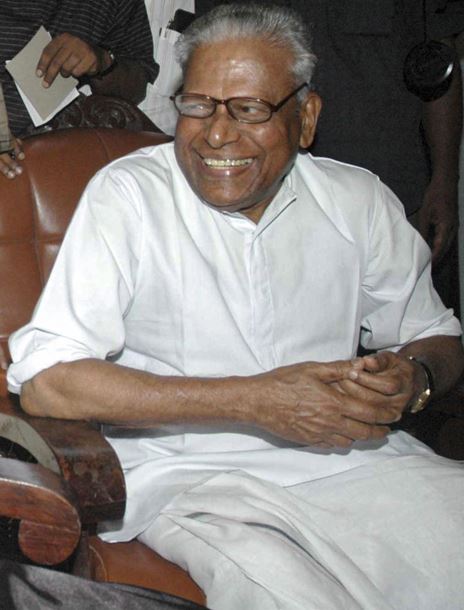
Some Lesser Known Facts About V. S. Achuthanandan
- V. S. Achuthanandan had a tough childhood as his mother died when he was four years old, and his father passed away when he was 11 years old.
- He stopped studying after completing 7th standard and began working in his elder brother’s tailoring shop in the village.
- Later, he worked in a coir factory, where he made ropes by meshing coir fibre. In the 1940s, he saw poor working conditions in the coir industry and began organising coir workers.
- He worked under Communist leader P. Krishna Pillai and started participating in labour union activities. He took part in the Punnapra-Vayalar uprising against the Travancore princely state and was arrested by the authorities.
- He was tortured in jail, received bayonet wounds on his feet, and spent over five years in prison. He also lived underground for more than four years to avoid arrest during that period.
- He joined the State Congress in 1938 through trade union work and shifted to the Communist Party of India (CPI) in 1940.
- In 1957, he became a state secretariat member of the CPI after years of political activity and leadership.
- During the 1962 India-China war, he organised blood donation camps for Indian soldiers, defying CPI’s official policy.
- Due to this action, he was arrested and removed from the CPI’s state secretariat post. In 1964, he was among 32 members who left the CPI National Council to form the Communist Party of India (Marxist).
- In the 1980s, he opposed nuclear power and large dam projects, which brought criticism from the CPI(M) leadership. He served as the Secretary of the Kerala State Committee of CPI(M) from 1980 to 1992.
- He was a Politburo member from 1985 but was later removed due to party disciplinary reasons. He was the senior-most leader of CPI(M) in India and remained influential for decades.
- In 1970, he led the Alappuzha declaration to implement the Land Reforms Act passed by the EMS Government in 1967.
- In 1996–97, he led a protest at Mankompu against the conversion of paddy fields into non-agricultural land. The protest was organised by the Kerala State Karshaka Thozhilali Union (KSKTU) and attracted public and media attention.
- The agitation turned violent when KSKTU workers began destroying crops to stop land use changes. Achuthanandan later expressed disapproval of the crop destruction done during the protest.
- In 2011, UDF Agriculture Minister K.P. Mohanan supported the objective of the 1996–97 stir despite political rivalry.
- In the 1990s and 2000s, he became a key political leader in Kerala and served as Leader of Opposition three times.
- He led several public campaigns against illegal land grabbing, lottery scams, and harmful corporate practices in Kerala.
- He opposed Coca-Cola’s operations in Plachimada for damaging local water resources used by nearby communities.
- He supported Adivasis during the Muthanga incident and protested against the endosulfan pesticide tragedy in Kasaragod district.
- During the Kerala Assembly elections in April–May 2006, V. S. Achuthanandan contested from Malampuzha constituency in Palakkad district and defeated Satheesan Pacheeni of the United Democratic Front by a margin of 20,017 votes in that election.
- On 18 May 2006, he was sworn in as the 11th Chief Minister of Kerala along with his 21-member cabinet. At the age of 82 years and 7 months, he became Kerala’s oldest Chief Minister and among the oldest in India.
- Two months earlier, he was denied a party ticket, but internal pressure led to a reversal of that decision.
- On 30 December 2007, he became the first Communist Chief Minister to trek to Sabarimala without any physical support. Despite being 84 years old, he completed the pilgrimage without medical aid, which raised concern among doctors.
- On 2 January 2008, the Kerala cabinet approved the Kochi Metro Rail project and sent it to the central government. In 2008, his government proposed an international airport at Mattannur, Kannur, in northern Kerala.
- On 12 July 2009, CPI(M) removed him from the Politburo due to his stance in the SNC Lavalin bribery case. He had opposed Pinarayi Vijayan’s involvement and the party’s approach to handling the case legally and politically.
- As Chief Minister, he opposed the India–ASEAN Free Trade Agreement, warning of damage to Kerala’s agricultural economy. He wrote to Prime Minister Manmohan Singh, stating Kerala was not consulted before signing the Free Trade Agreement.
- He argued that liberalised imports could hurt producers of coconut, pepper, rubber and edible oils, affecting one million livelihoods.
- In 2006, his government supported land acquisition for roads and railways for the Vallarpadam International Container Transshipment Terminal project. The terminal was inaugurated on 11 February 2011 and became India’s first container terminal in a Special Economic Zone (SEZ).
- In January 2009, his government announced the first district-level IT park at Kollam, called Technopark Kollam. He laid the foundation stone in February 2009, and inaugurated the first phase on 15 February 2011.
- In 2009, his ministry initiated Infopark Cherthala in Alappuzha and expanded Kochi Infopark to surrounding satellite towns. He laid the foundation for Infopark Phase 2 at Kakkanad, which was planned on 160 acres of land.
- His government also started work on Cyberpark in Kozhikode to boost IT sector development in northern Kerala. His term saw major growth in IT exports from Kerala, which surpassed the national average during that period.
- On 17 December 2010, he laid the foundation stone for Kannur International Airport along with Civil Aviation Minister Praful Patel.
- The Ashtamudi tourism circuit in Kollam district was also developed to promote regional tourism during his leadership.
- He took legal action to stop encroachments in Munnar by launching anti-land grab drives in the hill station area. His government filed a case against the resort mafia and passed an ordinance to take over the Kovalam Palace.
- He led action against the illegal lottery mafia operating in the state and ordered closure of several operations.
- Achuthanandan filed a legal case against the Malayala Manorama group for encroaching 400 acres of Panthaloor temple land.
- He won the case, ensuring the return of 162 hectares of land from the media group to public ownership. Other Initiatives
- He laid the foundation stone of the Chamravattom Regulator-cum-Bridge project in Malappuram district, a key irrigation and transport initiative.
- He supported the free and open-source software movement in Kerala and received public support from activist Richard Stallman. During his tenure, major expansions were made to Technopark in Thiruvananthapuram, including Technopark Phases 2, 3 and Technocity.
- In 2010, PFI members chopped Kerala professor T.J. Joseph’s hand over an exam question seen as blasphemous. After the incident, Achuthanandan accused PFI of trying to turn Kerala into a Muslim-majority state within 20 years. He said PFI used money and marriage to convert people and warned it was a dangerous trend.
- Pinarayi Vijayan supported Achuthanandan but warned against misuse of religion in politics. In 2022, the Indian government banned PFI under UAPA for alleged extremist activities.
- On 4 May 2012, T.P. Chandrasekharan, politician and the founder of Revolutionary Marxist Party (RMP), was murdered. In June 2012, during Neyyattinkara by-election, Achuthanandan defied party orders and visited KK Rema at her home.
newspaper Recent News
Recent news and updates about V. S. Achuthanandan will appear here.
Similar Celebrities
VIEW ALLChampai Soren
Politician • Indian
Praful Patel
Politician, Businessman, Philanthropist • Indian
K Armstrong
Politician, Advocate • Indian
Sulakshana Sawant (Pramod Sawant’s
Politician, School Teacher, and Social Worker • Indian
A. K. Roy
Politician • Indian
Ajay Maken
Politician • Indian
Gaurav Gogoi
Politician • Indian
Baby Rani Maurya
Politician • Indian
Poonamben Maadam
Politician • Indian
Asha Paswan
Politician • Indian