Yusuf Hamied
Net Worth
In 2022, his net worth was estimated at approximately $ 3.9 billion. Forbes
Height
in centimeters- 165 cm in meters- 1.65 m in feet & inches- 5’ 5”
Age
87
Nation
Indian
favorite Personal Life
Basic Information
Family & Relationships
Education
Lifestyle
person_book Biography
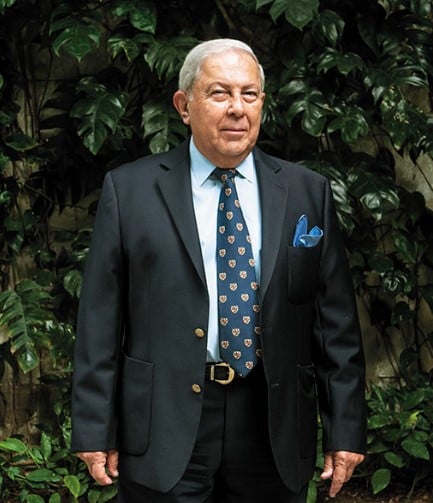
Some Lesser Known Facts About Yusuf Hamied
- Yusuf Khwaja Hamied is an Indian scientist and a prominent businessman. He is the chairman of Cipla, an Indian company that makes generic medicines. His father, Khwaja Abdul Hamied, started the Cipla company in 1935. Yusuf Hamied is a fellow member of the Indian National Science Academy.
- In 1925, his father, K.A. Hamied, met Luba Derczanska on a boat ride in Berlin. They fell in love and married in 1928 in Berlin’s mosque, then again in Vilnius’s temple and London’s Register Office in 1929. Luba was part of communist groups and introduced K.A. Hamied to them, although he later had concerns about communism. They were studying at a university in Berlin during that time.
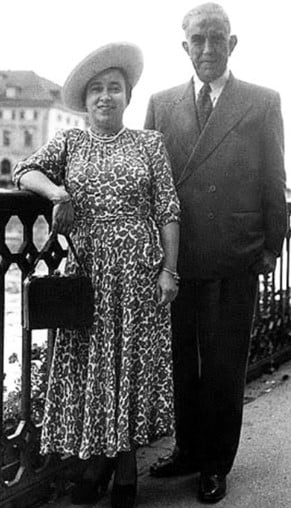
The parents of Yusuf Hamied
- Yusuf Hamied’s father, Khwaja Abdul Hamied, was born in Aligarh. His grandfather, Khwaja Abdul Ali, belonged to an influential family of past Indian leaders like Khwaja Ubaidullah Ahrar from Uzbekistan. Khwaja Abdul Ali’s mother, Masud Jehan Begum, came from the family of Shah Shuja ul-Mulk.
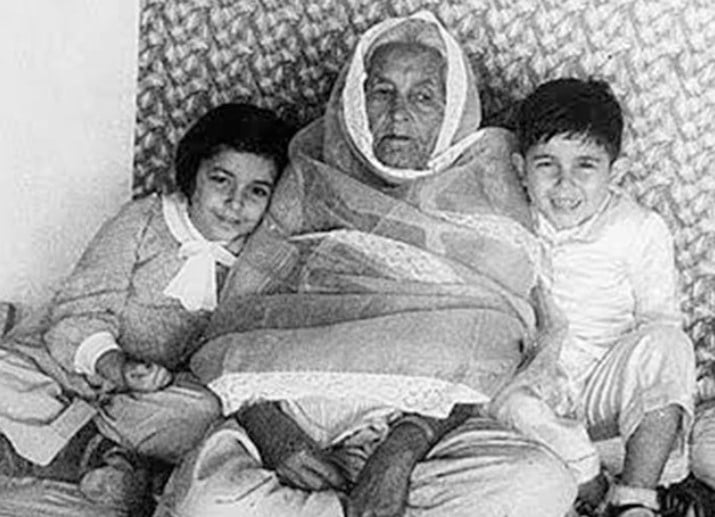
Yusuf and Sophie with their paternal grandmother Masud Jehan Begum
- This Shah was in charge of Afghanistan and was a friend of the Britishers (1803-1809 and 1839-1842), but he was killed when his people fought against the British. Subsequently, Khwaja Abdul Ali’s family moved to India. Khwaja Abdul Ali had an uncle named Sir Syed Ahmed Khan who was a great Muslim educationalist and social reformer.
- In India, Khwaja Abdul Ali worked for the British government in India’s legal system. His son K.A. Hamied was against foreign rule and supported Mahatma Gandhi‘s non-cooperation movement against the British. When Gandhi said to avoid government schools, K.A. Hamied led a protest at his college named Muir Central College in Allahabad. He got kicked out of the college and was arrested for trying to disturb graduation events. K.A. Hamied then went back to Aligarh, where Muslim leaders made a new university called Jamia Millia Islamia. K.A. Hamied taught chemistry there and also helped make and sell homespun cloth (khadi), which Gandhi used to show as a symbol of Indian unity. K.A. Hamied once met Gandhi, Motilal Nehru, and Jawaharlal Nehru at his maternal uncle’s house.
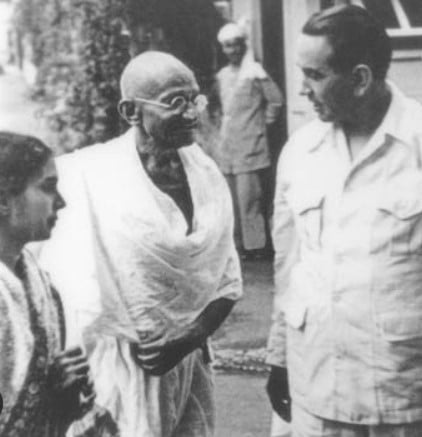
K.A. Hamied with Mahatma Gandhi
- Yusuf Hamied was born in Vilnius during his parents’ final trip to Berlin in 1936 before the Holocaust (the genocide of European Jews during World War II). His name was chosen because it was related to Luba’s family and Polish friends. A month later, Yusuf’s parents brought him to Bombay.
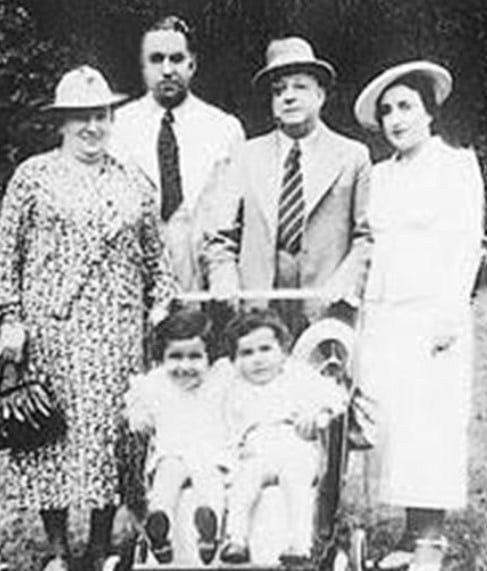
A childhood picture of Yusuf Hamied and Sophie Hamied with their parents and maternal grandparents
- His father, K.A. Hamied, wrote in The Times of India in 1964 that patent law should make sure that other companies could also make certain medicines to stop unfair high pricing by only one company. Later, Yusuf took on a similar fight against very high prices set by patent owners for AIDS drugs and recreated the first effective HIV and AIDS medications and sold them at a much lower cost. Thinking about the loss of his grandparents and many Jews in the Holocaust during World War 2, Yusuf then criticized big pharmaceutical companies as “global serial killers” and accused them of making money from death. According to him, not letting poor people in developing countries access life-saving medicines due to high costs is like an unfair “selective genocide in healthcare” led by these companies for the desire for money.
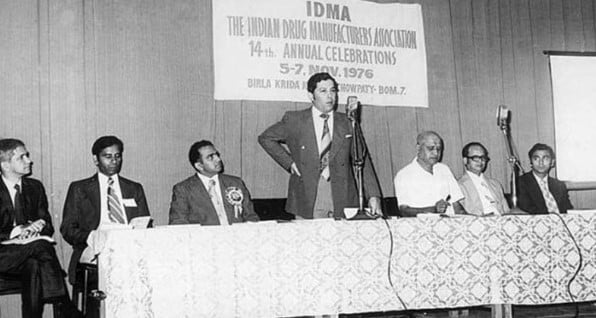
Yusuf Hamied addressing the Indian Drug Manufacturers Association in 1976
- Yusuf Hamied is known outside India for standing up against big Western drug companies. He stood up against monopolies in the medicine sector to offer affordable AIDS medicines and treatments for illnesses that mainly affect people in poor countries. He has worked hard to stop AIDS in developing countries and made sure sick people get important medicines, no matter if they could pay or not. In 2012, he stated the reason for not making money out of the deadly diseases. He said,
I don’t want to make money off these diseases which cause the whole fabric of society to crumble.”
- Hamied has played an important role in creating new types of medicines that have more than one drug combined called combination pills. These pills help with HIV/AIDS, tuberculosis, asthma, and other illnesses that are common in poor developing countries. He also worked on making medicines for children and making sure that medicines were safe and given in the right amounts. He is also known for helping India in producing the main chemicals, which are used in medicines.
- In 2008, Yusuf visited the place where he was born, Vilnius, and was deeply touched by the Ponary forest, where many people, mostly Jews, were killed by German units. He later decided to put up the statues of Mahatma Gandhi and his friend Hermann Kallenbach in Vilnius. At the same time, to honour his mother, he arranged a concert with his long-time friend Zubin Mehta in the same city.
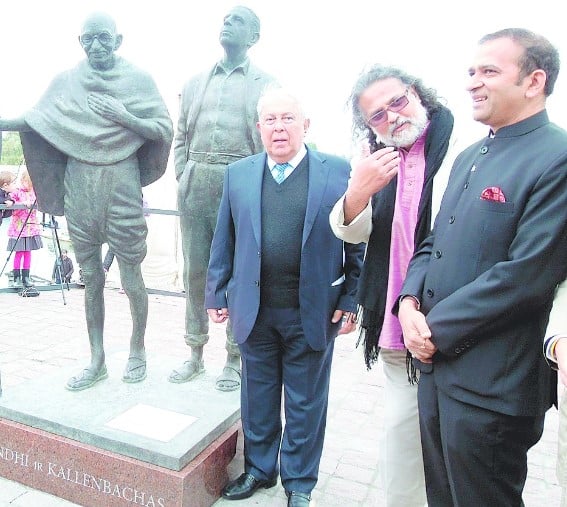
Yusuf Hamied posing with the statues of Mahatma Gandhi and Hermann Kallenbach in Vilnius
- Even though Luba did not practice her Jewish faith much, her son Yusuf Hamied later decided to honour her memory by reconstructing the Shaar Hashamaim Synagogue in Thane, Mumbai.
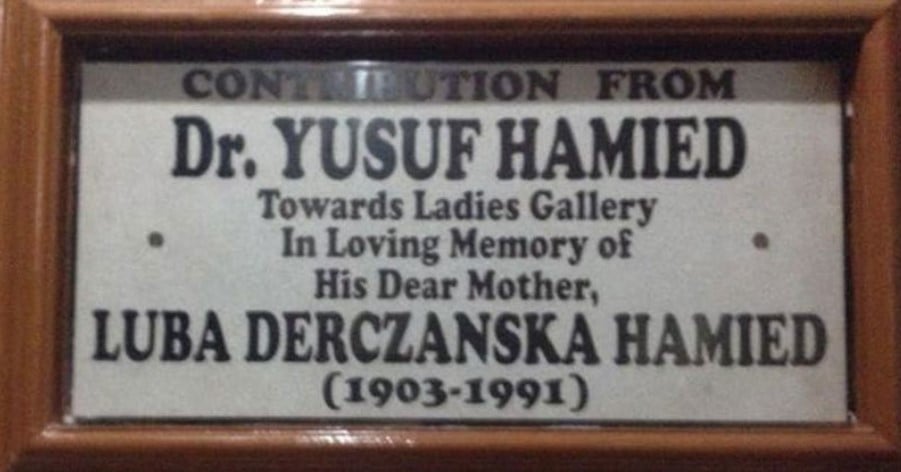
Shaar Hashamaim Synagogue in Thane
- In 2009, the Yusuf Hamied Centre was started at Christ’s College, University of Cambridge. The centre has a bronze statue of Yusuf Hamied. This statue was designed by his fellow Christ’s College alumnus, Anthony Smith. The college also has a special chemistry post called ‘Todd-Hamied Fellow’ in his name. This post was held by Professor Chris Abell until he passed away in October 2020.
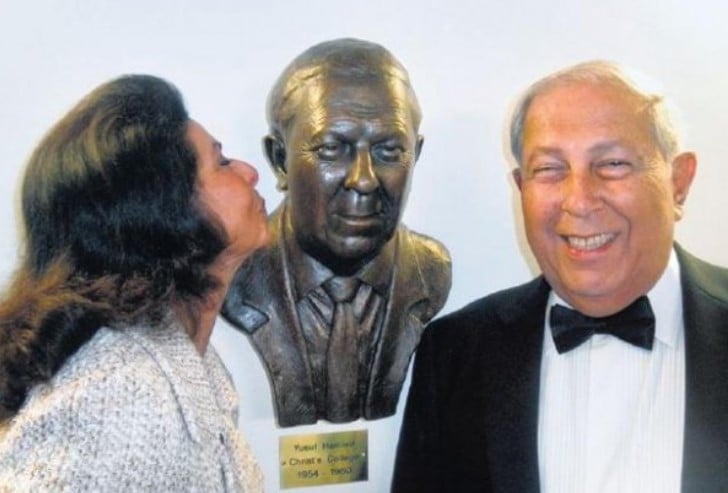
Yusuf’s wife Farida Hamied while kissing her husband’s statue
- According to Yusuf Hanmied, when he creates new medicines, he refers to his chemistry notebooks from his time at Cambridge.
- In September 2011, The New York Times wrote about Hamied, and his working to make biotech drugs cheaper for illnesses like cancer and diabetes. It wrote,
Dr. Yusuf K. Hamied, chairman of the Indian drug giant Cipla Ltd., electrified the global health community a decade ago when he said he could produce cocktails of AIDS medicines for $1 per day — a fraction of the price charged by branded pharmaceutical companies. That price has since fallen to 20 cents per day, and more than six million people in the developing world now receive treatment, up from little more than 2,000 in 2001.”
- The documentary film “Fire in the Blood” (2013) shows how Hamied played crucial in the fight to provide many people in Africa with antiretroviral treatment. After the release of the film, a review by India Today magazine stated that Hamied’s story would make Indians proud because he chose to help people by selling medicines to save lives, instead of focusing on profits.

The poster of the documentary film Fire in the Blood (2013)
- In February 2013, Hamied retired from his role as the managing director of Cipla. He served in this position for 52 years.
- One of the three children of Cipla’s non-executive vice-chairman, M. K. Hamied, named Samina Vaziralli, joined the leadership of Cipla in 2015.
- In 2017, he was interviewed for a project titled ‘Creating Emerging Markets’ at Harvard Business School. In the interview, he talked a lot about his plans to offer AIDS treatments and other medicines to help people in developing countries who do not have much money.
- In 2018, Yusuf Hamied made monetary donations to the chemistry department at Cambridge University to support the oldest professorship in the subject called ‘the 1702 Chair of Chemistry.’ Cambridge University renamed this as the Yusuf Hamied 1702 Chair in his honour. There are also special places in the department named after him and his mentor Alexander Todd. In 2020, after his huge monetary donation, its chemistry department was renamed after him and a special program for scholars was initiated. He frequently contributes donations to IISER Pune for its chemistry faculty.
- Many famous newspapers and magazines like The New York Times, Time magazine, and The Guardian, along with TV channels like ABC News, the BBC, CNN, and CBS’ 60 Minutes, often publishes detailed stories about him.
- Under his guidance, in 2020, Cipla produced various medicines for treating the Covid-19 virus. This includes a type of medicine called Remdesivir under the licence from Gilead Sciences.
newspaper Recent News
Recent news and updates about Yusuf Hamied will appear here.
Similar Celebrities
VIEW ALLNaval Tata
Businessman, Philanthropist • Indian
Carol Gracias
Model and Businesswoman • Indian
Harsh Goenka
Businessman • Indian
Zen Sajnani
Software Engineer, Entrepreneur • Indian
Dinesh Chandra Agrawal
Businessman • Indian
Asish Mohapatra
Entrepreneur • Indian
Ramneek Sharma (Bobby Darling’s
Businessman • Indian
Mark Zuckerberg
Computer Programmer, Internet Entrepreneur • American
Grecia Muñoz
Model, Entrepreneur • Mexican
Rohit Gupta
Comedian, Entrepreneur, YouTuber • Indian