Karsandas Mulji
Age
1
Nation
British Indian
favorite Personal Life
Basic Information
Family & Relationships
Education
Lifestyle
person_book Biography
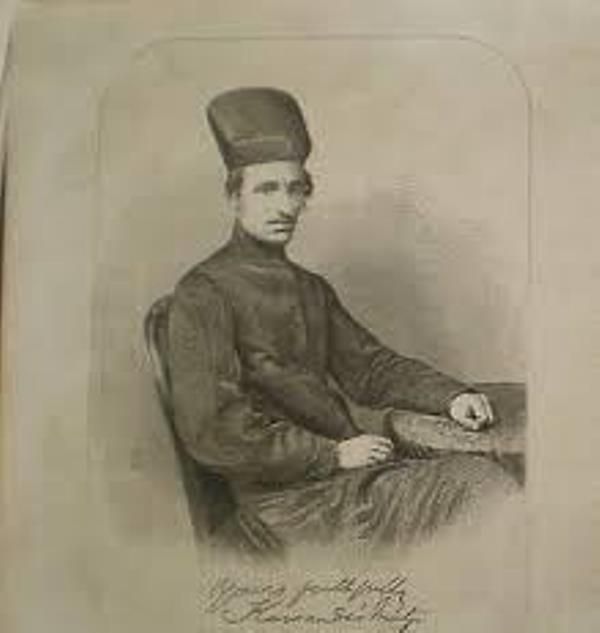
Some Lesser Known Facts About Karsandas Mulji
- Karsandas Mulji belonged to an orthodox Pushtimarg merchant family, who were highly respected in Bombay.
- His mother died when he was a child. He was later looked after by one of his elderly aunt.
- He once wrote an essay on widow remarriage for a literary competition. When his family came to know about it, they disowned him from the family.
- He, then, started working at a charitable school founded by Sheth Gokuldas Tejpal. He secured that job through a scholarship, which he earned after passing an examination.
- While studying in college, he was a member of the Gujarati Gyan Prasarak Mandali (Gujarati Society for the Spread of Knowledge), which was founded by the Students’ Society of Elphinstone College.
- He had to drop out of college after he was disowned by his family.
- Prominent Gujarati poet Narmadashankar Lalshankar Dave (popular as Narmad) and educationist Mahipatram Rupram Nilkanth were his classmates in college.
- In 1851, he started working as a journalist for the Anglo-Gujarati newspaper Rast Goftar.
- He got recognition as a reformer for the first time in 1853, after he published an essay advocating foreign travel. It was read in front of Buddhi Vardhak Hindu Sabha.
- In 1855, he launched a Gujarati language weekly newspaper named ‘Satyaprakash’ with an intention of social reform. The weekly was ran till 1861 and later got merged with Rast Goftar.
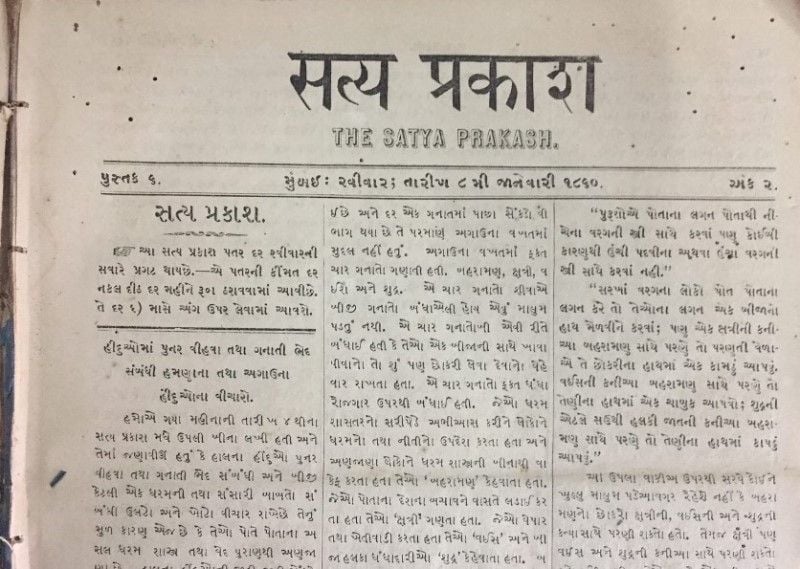
An excerpt from Satyaprakash weekly
- In 1857, he co-founded a women’s magazine named ‘Stribodh.’ He also published a weekly called ‘Mumbainu Bajar’ (the Bombay Market).
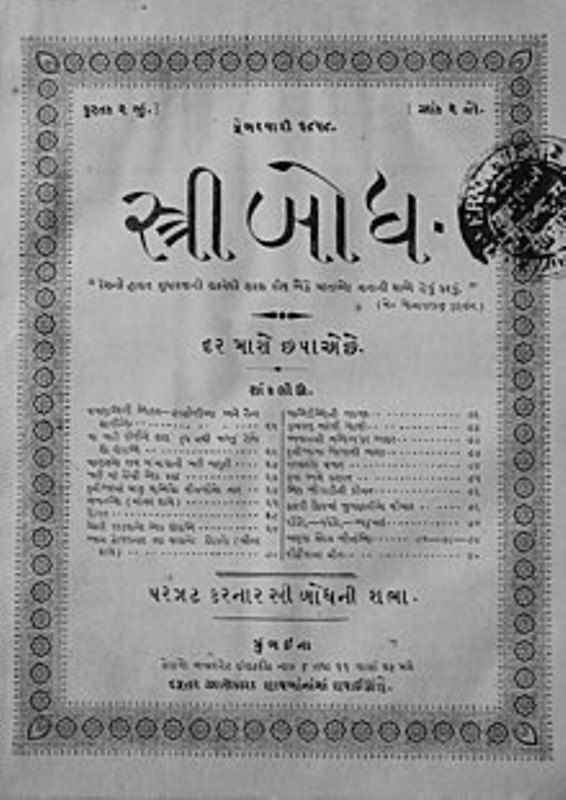
Cover of the magazine ‘Stribodh,’ issue of February 1858 (vol. 2, no.2)
- Mulji had often discussed the social issues like female education, excessive spending on grand marriages, indecent songs sung during marriages, and the funeral ritual of chest beating in his articles.
- His article, ‘Gulamikhat’ (Letter of slavery), is one of his most notable articles from the weekly Satyaprakash. In the article, he criticized the sign campaign and law-making process of the Vaishnavas. He opposed the rule that Maharaj (religious heads) should not have to visit the court because of their religious status.
- Following the publication of the article, many religious heads tried to bribe him, but he refused. Later, he wrote the articles ‘Maharajo ne vinanti’ (Request to Maharaj) and ‘Dharmguruo ni satta’ (Power of religious leaders) in which he expressed his anger towards Vaishnava religious heads.
- Later, Vaishnava religious heads started publishing a pamphlet titled “Swadharmvardhak ane Sanshaychedak” (Increasing one’s own faith and countering doubts) in which they called Mulji and other social reformers greedy, atheists, and idiots.
- In response of it, Mulji took to his weekly to accuse the religious heads of being frauds. Later, the Vaishnava religious head Jadunath Maharaj wrote an article in ‘Chabuk,’ to which Mulji responded with another article titled ‘Hinduo No Asli Dharam Ane Atyar Na Pakhandi Mato’ which led to the Maharaj Libel Case in 1862.
- In 1863, he went on to travel foreign countries with Ramchandra Balkrishna Jaykar, founder of the Paramahamsa Sabha.
- Mulji was often criticized by his caste leaders for his staunch reformist perspective. They also tried to banish him from his Kapol Vaniya caste, but failed to do so.
- He once visited England for a business in connection with the cotton trade, but it went unsuccessful.
- After winning the Maharaj libel case in 1862, he earned several titles such as ‘a Reformer,’ ‘a Martin Luther of the Banian Cast,’ and ‘Indian Luther.’
- Reportedly, he was appointed to administer a native state in Kathiawar, Gujarat in 1874.
- He had also worked as an assistant superintendent of Rajkot state. During his tenure there, he published a monthly journal titled ‘Vignanvilas,’ where he wrote on the topics related to science and industry.
- He wrote several books including “History of the Sect of Maharajas or Vallabhacharyas, in Western India” (1865) and “Travels in England” (1866).
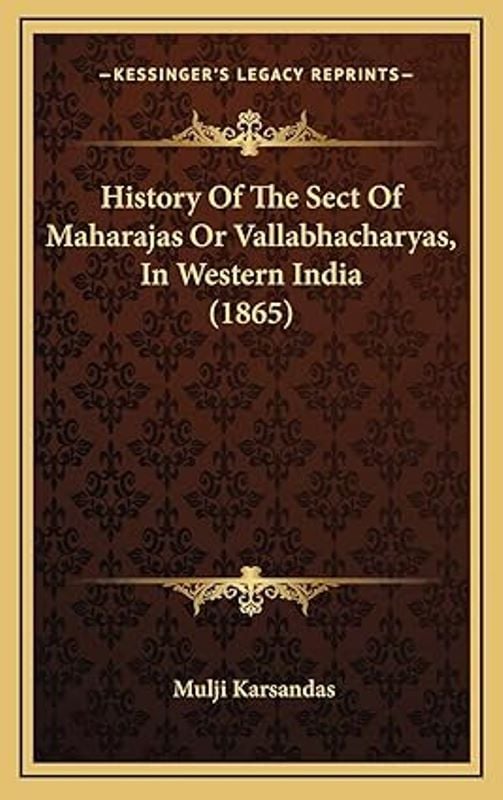
Cover of the book ‘History of the Sect of Maharajas or Vallabhacharyas, in Western India’
- After his death, the Bombay University constituted the Karsandas Mulji prize for the best student essay in his memory.
- He was often mocked for wearing trousers which was a typical instance of Macaulay man.
- In 1877, Mahipatram Rupram Nilkanth wrote his biography in Gujarati language titled “Uttam Kapol Karsandas Mulji Charitra.” The introductory section of the book was written in English language.
- In 1935, a critical biography of Karsandas Mulji was written by B. N. Motiwala which titled ‘Karsandas Mulji: A Biographical Study.’
- In 2024, a film named ‘Maharaj’ was announced, based on the Maharaj Libel Case in 1862. In the film, his character was portrayed by Aamir Khan‘s son Junaid Khan.
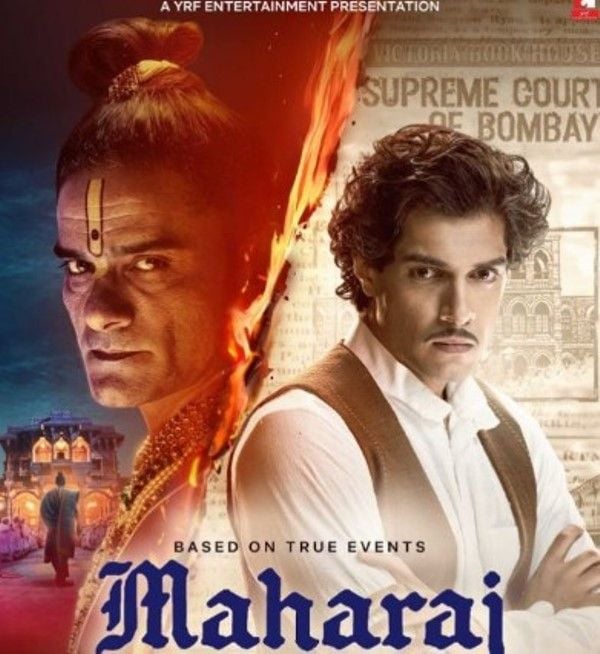
Poster of the film ‘Maharaj’
newspaper Recent News
Recent news and updates about Karsandas Mulji will appear here.
Similar Celebrities
VIEW ALLShikha Srivastava (Raju Srivastava’s
Indian
Clive Myrie
Journalist, Newsreader, Presenter, Motivational Speaker • British
“Host
Tapasya Parihar (IAS 2017)
Indian
Nitara Kumar Date of Birth,
Indian
Mahsa Amini
Iranian
Nirdosh Kaur (Jaswant Singh Gill’s
Indian
Harkamal Singh (Harkamal Ranu)
Indian
Pradeep Bhandari
Journalist (News Anchor) • Indian
Rana Ayyub
Journalist, Author, Columnist • Indian